Why Understanding Cavity Filling Cost Near Me Matters
Cavity filling costs is one of the most common dental searches for good reason—approximately 90% of adults have experienced tooth decay, and understanding what you’ll pay before sitting in the dental chair helps you plan and avoid financial surprises. Whether you’re dealing with your first cavity or need multiple fillings, knowing the price range empowers you to make informed decisions about your oral health.
Quick Answer: What You’ll Pay for a Cavity Filling
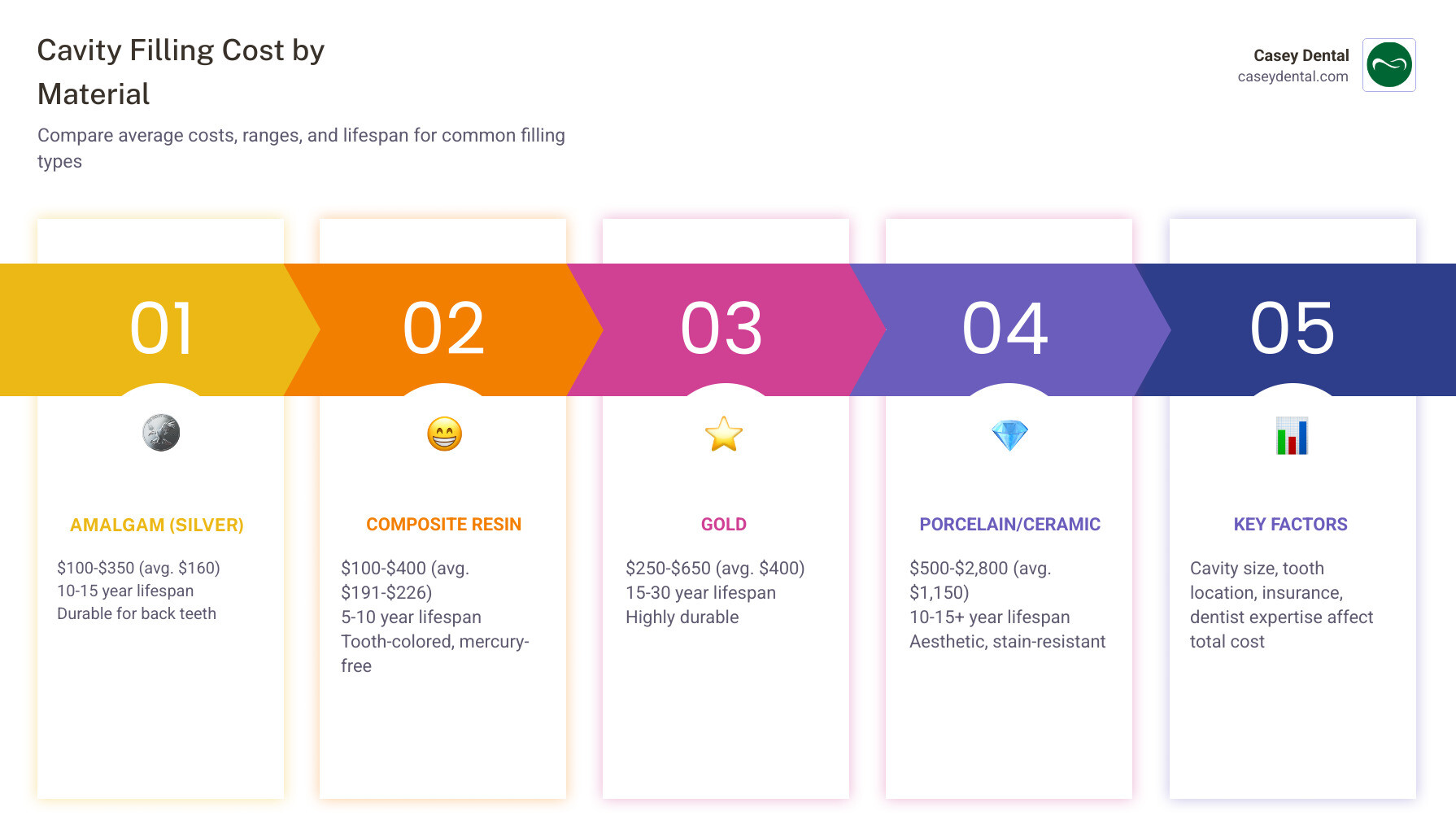
- Amalgam (silver) fillings: $100-$350 per tooth (average $160)
- Composite resin (tooth-colored): $100-$400 per tooth (average $191-$226)
- Gold fillings: $250-$650 per tooth (average $400)
- Porcelain/ceramic: $500-$2,800 per tooth (average $1,150)
- With insurance: Typically 50-80% covered, leaving $30-$150 out-of-pocket
- Without insurance: $200-$600 on average, but can range from $100-$4,000
The cost varies based on the filling material you choose, the size and location of your cavity, your insurance coverage, and where you live. Treating a cavity early almost always costs less than waiting—a small filling today may become a crown or root canal tomorrow.
If you’ve been told you have a cavity, getting your tooth drilled to repair it probably sounds unpleasant enough. But there’s also the legitimate concern of how much the procedure will cost and whether you can afford it right now. The good news is that cavity fillings remain one of the most common and straightforward dental procedures, with predictable costs and multiple payment options available.
Why acting quickly saves you money: By the time a cavity causes pain, it’s often reached the nerve and requires more extensive (and expensive) treatment. A $200 filling addressed today prevents a $2,500 root canal and crown six months from now.
I’m Dr. Shawn Casey, and I’ve been providing comprehensive dental care to families in northeast Pennsylvania since 1994, helping thousands of patients understand their treatment options and navigate cavity filling costs concerns with transparent pricing and flexible payment solutions. At Casey Dental, we believe financial transparency is just as important as clinical excellence, which is why we’ll always discuss costs upfront and work with you to make necessary care affordable.
Understanding Cavity Filling Cost Near Me by Material
When you start looking for cavity filling costs, the first thing you will notice is that the price varies wildly depending on what the filling is made of. It’s a bit like choosing the material for a kitchen countertop—you can go with the functional, budget-friendly option or the high-end, custom-fabricated masterpiece.
Dental fillings can last for years, but their longevity depends heavily on the material chosen. At Casey Dental, we want you to understand exactly what tooth fillings are made of so you can balance your budget with your aesthetic goals.
| Material Type | Average Cost | Expected Lifespan | Best Use Case |
|---|---|---|---|
| Silver Amalgam | $160 | 10–15 Years | Back molars (heavy chewing) |
| Composite Resin | $191–$226 | 5–10 Years | Front teeth or visible areas |
| Gold Inlays | $400–$1,000 | 15–30 Years | Maximum durability |
| Porcelain/Ceramic | $1,150 | 10–15+ Years | Large cavities/stain resistance |
Silver Amalgam: The Durable, Low-Cost Option
Silver amalgam fillings have been the “old reliable” of dentistry for over a century. These are made from a metal alloy—a mixture of silver, tin, copper, and elemental mercury. Despite common misconceptions, the American Dental Association confirms that the mercury is bound with other metals, releasing minimal vapor and remaining safe for the vast majority of patients.
Because they are averaging around $160 per tooth, they are often the go-to for patients who are strictly budget-conscious. Amalgam is incredibly strong and less prone to breaking than other materials, making it ideal for posterior teeth (your back molars) where the pressure from chewing is highest. The trade-off? They are silver in color and can darken over time, so they aren’t usually the first choice for your “smile zone.”
Composite Resin: The Most Popular Cavity Filling Cost Near Me
If you are worried about people seeing metal in your mouth when you laugh, composite resin is likely the choice for you. This is the most popular type of dental filling today. These tooth-colored fillings are made of a mixture of plastic and glass that bonds directly to your tooth structure.
While the national average for composite resin is roughly $191 to $226, the price can fluctuate based on how many “surfaces” of the tooth need filling. Because composite requires a more time-intensive placement technique—including specialized bonding agents and UV light curing—it costs more than amalgam. However, for most of our patients in Pittston, the ability to have a filling that is virtually invisible is worth the small price increase.
Premium Restorations: Gold and Ceramic Inlays
For those looking for the “luxury” version of dental care, gold and porcelain are the top-tier options. Gold fillings (often called inlays or onlays) provide unmatched durability, sometimes lasting up to 30 years. However, they are rare today because they require at least two visits and have a very high material cost.
Porcelain or ceramic fillings cost around $1,150 on average, but they can climb as high as $2,800. Why the high price tag? These are often fabricated in a dental lab to fit your cavity perfectly. They match natural tooth color better than any other material and are highly resistant to staining. If you have a large cavity but want to avoid a full crown, a porcelain inlay is a fantastic, albeit expensive, middle ground.
Factors That Influence Your Total Dental Bill

When you call a dentist asking for a cavity filling cost near me, you might hear a range rather than a flat fee. This isn’t the dentist being cagey; it’s because several clinical factors determine the complexity of the job. Understanding tooth decay and cavities helps explain why one filling might cost $150 while another costs $400.
- Cavity Size and Number of Surfaces: Dentists bill based on how many sides of the tooth are affected. A “one-surface” filling is a simple hole on the top of the tooth. If the decay has spread between teeth, you’re looking at a two, three, or even four-surface filling, which requires more material and more time.
- Tooth Location: Filling a front tooth requires a high level of artistry to match the shade and shape of your smile. Conversely, filling a wisdom tooth at the very back of the mouth can be technically difficult due to limited access, which may influence the cost.
- Additional Procedures: Sometimes a filling isn’t just a filling. You may need a routine dental exam (national average $203) or X-rays ($25–$50) to diagnose the problem. If you have dental anxiety and require nitrous oxide (laughing gas), that can add another $50–$100 to the bill.
Front Teeth vs. Back Teeth Considerations
The location of your cavity significantly dictates the material we recommend. For front teeth, we almost exclusively use composite resin or porcelain to ensure your smile looks natural. For back teeth, we have more flexibility. You can read more about our specific dental filling services to see how we approach different areas of the mouth. While amalgam is strong for molars, many of our Pennsylvania patients prefer tooth-colored composite even for back teeth to keep their dental work discreet.
Geographic Location and Regional Pricing
Believe it or not, your zip code matters. Dental costs can be affected by the local cost of living and the overhead expenses of the practice. In Pennsylvania, the average cost for a dental exam is around $198, which is slightly lower than the national average. Within the state, you might find that prices in urban centers like Pittston or Wilkes-Barre differ slightly from more rural areas, though at Casey Dental, we strive to keep our Pittston and Luzerne County prices competitive and fair for our community.
Navigating Insurance and Out-of-Pocket Expenses
Insurance is often described as a “double-edged sword” in dentistry. While it can significantly lower your cavity filling cost near me, it also comes with rules and limitations. Most dental plans classify fillings as “Basic Restorative Services” and typically cover 50% to 80% of the cost after you’ve met your deductible.
For example, if you have a plan like the Cigna Dental 1000, and you get a $160 amalgam filling from an in-network dentist, the plan might pay 80% ($128), leaving you with a $32 copay.
Estimating Your Cavity Filling Cost Near Me Without Insurance
If you don’t have insurance, don’t panic. Many patients pay for their dental fillings in Pennsylvania out of pocket. Without insurance, you can expect to pay between $200 and $600 for the average filling.
To make this more manageable, we recommend:
- HSA/FSA Accounts: Use your Health Savings Account or Flexible Spending Account to pay for dental work with pre-tax dollars.
- Payment Plans: Many offices, including ours, offer third-party financing like CareCredit, which allows you to break the cost into monthly installments.
- Cash Discounts: Some dentists offer a small discount (often 5-10%) if you pay the full amount in cash on the day of treatment.
Common Coverage Limitations and Waiting Periods
It is vital to check your waiting period before scheduling. Some plans require you to be a member for 6 to 12 months before they will pay for “basic” work like fillings.
Additionally, be aware of the “Amalgam Downgrade” rule. Some insurance companies will only pay for the cost of a silver filling, even if you choose a tooth-colored composite on a back molar. In this case, you would be responsible for the price difference between the two materials.
How to Find Affordable Care and Save Money
We understand that dental care is an investment, and sometimes that investment comes at a difficult time. If the cavity filling cost near me is currently out of reach, there are several avenues for finding budget-friendly care in Pennsylvania:
- Dental Schools: You can find a dental school where students perform procedures under the strict supervision of licensed instructors. This can save you 30% to 50% off standard rates.
- Medicaid: For qualifying low-income individuals and families, Medicaid provides dental coverage that often includes 100% of the cost of fillings.
- Community Health Centers: Many regions have clinics that offer sliding-scale fees based on your income. You can contact your local health department to find a facility near Pittston or West Pittston.
- Preventative Care: The absolute best way to save money on fillings is to not need them! Regular brushing, flossing, and $200 cleanings prevent thousands of dollars in future dental bills.
The High Price of Procrastination: Why Waiting Costs More
One of the most dangerous phrases in dentistry is “It doesn’t hurt yet.” Bacteria causing tooth decay don’t take breaks. A small cavity that could be fixed with a $150 filling today will continue to eat through your enamel.
According to our research, here is how the cost escalates if you wait:
- Month 0 (Small Cavity): $150–$250 for a simple filling.
- Month 6 (Cavity Grows): $300–$400 as the decay covers more surfaces.
- Month 12 (Reaches Nerve): $1,500–$2,500 for a root canal and a crown.
- Month 18 (Infection Spreads): $3,000–$5,000 for extraction, bone grafting, and a dental implant.
We cannot stress enough the importance of dental care and early intervention. Treating a cavity when it’s small is not only easier on your mouth but significantly easier on your wallet.
Frequently Asked Questions About Filling Costs
What is the average cost of a cavity filling?
The national average for the most common filling (composite resin) is between $191 and $226. Silver amalgam is slightly cheaper, averaging $160. However, without insurance, most patients should budget between $200 and $600 to cover the exam and the procedure.
How can I compare prices from different dentists in my area?
The best way is to call local offices and ask for their “UCR” (Usual, Customary, and Reasonable) fees for specific ADA codes. For a standard back-tooth white filling, ask for the price of code D2391 (one surface) or D2392 (two surfaces). Just remember that a low price shouldn’t be the only factor—experience and technology matter too!
Does insurance cover tooth-colored fillings on molars?
Most modern plans do, but some older or more restrictive plans may “downgrade” the coverage to the silver amalgam rate. If your dentist charges $250 for composite and $150 for amalgam, the insurance might only pay their percentage of the $150, leaving you to pay the remaining $100 plus your copay.
Conclusion
At Casey Dental, we are proud to serve the Pittston, PA community, including Luzerne County and West Pittston. Our goal is to provide award-winning, comprehensive family dentistry that utilizes cutting-edge technology without losing the personal touch that makes our patients feel like family. We believe that by providing clear information about cavity filling costs, we can help you take control of your oral health.
If you are concerned about a potential cavity or experiencing tooth pain, don’t wait for the problem to escalate into a costly emergency. Casey Dental offers award-winning, high-quality care for patients of all ages in Pittston, PA, ensuring your treatment is both effective and affordable. We also provide emergency dental services for those in immediate need. To maintain your results between visits, explore professional-grade oral care products in our patient store. Contact us today to schedule your consultation and keep your smile healthy.