
What Adults Really Need to Know Before Getting Braces
If you’re researching braces for adults what to expect, here’s a quick summary before we dive deeper:
What to expect with adult braces:
- A consultation with X-rays, imaging, and a custom treatment plan
- A fitting appointment lasting 1 to 2 hours
- Some soreness and adjustment in the first few days
- Treatment lasting roughly 18 to 30 months depending on your case
- Regular adjustment visits every 4 to 8 weeks
- A retainer after treatment to keep your results
Braces aren’t just for teenagers anymore. In fact, one in five orthodontic patients today is over the age of 18 — and that number keeps climbing. Adults are choosing treatment for a wide range of reasons: shifting teeth, bite problems, difficulty flossing, jaw discomfort, or simply a smile they’ve always wanted to fix.
The good news? Modern orthodontic treatment is more comfortable, more discreet, and more effective than ever before. Whether you’re considering traditional braces or clear aligners, there’s likely an option that fits your lifestyle and your goals.
I’m Dr. Shawn Casey, founder of Casey Dental and a Doctor of Dental Medicine with over 30 years of experience helping patients across northeast Pennsylvania. Having guided many adults through the process of braces for adults — what to expect, how to prepare, and how to maintain results — I want to give you an honest, straightforward guide so you can make a confident decision. Let’s walk through everything, step by step.
Why More Adults Are Choosing Orthodontic Treatment
It is May 2026, and the trend of adult orthodontics has never been stronger. We see it every day at our Pittston office: more adults are realizing that a straight smile is an investment in both their health and their professional presence. While many of our patients start the journey for aesthetic goals, they are often surprised by the functional benefits that follow.
Are Braces Worth It for Adults? The answer is a resounding yes for many reasons. Beyond just looking great, properly aligned teeth are significantly easier to clean. When teeth are crowded or overlapping, it’s nearly impossible for a toothbrush or floss to reach every surface. By straightening your smile, you reduce the risk of plaque buildup, tooth decay, and gum disease.
Furthermore, many adults suffer from Temporomandibular Joint Disorder (TMD), which can cause chronic jaw pain and headaches. In fact, statistics show that approximately 12 million people deal with TMD often caused by a misaligned bite. Orthodontic treatment can provide much-needed TMD relief by correcting how your upper and lower teeth meet.
Another common reason for seeking treatment is relapse prevention. Many of us had braces as teens but perhaps weren’t as diligent with our retainers as we should have been. As we age, our teeth naturally shift. Correcting this relapse can restore the confidence you felt right after your first round of treatment. To learn more about the basics, check out our guide on What Are Teeth Braces? Everything You Need to Know.
Common adult dental misalignments we treat include:
- Overcrowding (teeth overlapping due to lack of space)
- Diastema (gaps or spaces between teeth)
- Overbite (upper teeth protruding too far over lower teeth)
- Underbite (lower teeth sitting in front of upper teeth)
- Crossbite (upper teeth sitting inside lower teeth)
Braces for Adults: What to Expect Regarding Treatment Options
One of the first questions we hear is, “Do I have to wear metal brackets?” The answer depends on your specific needs, but today’s adults have more choices than ever. We focus on finding the balance between treatment efficiency and your personal lifestyle.
| Feature | Metal Braces | Ceramic Braces | Clear Aligners (Invisalign) |
|---|---|---|---|
| Visibility | High | Low (Tooth-colored) | Very Low (Clear plastic) |
| Removability | Fixed | Fixed | Removable |
| Treatment Speed | Fast/Reliable | Reliable | Variable (Compliance-based) |
| Dietary Restrictions | Yes | Yes | No (Remove to eat) |
| Complexity | Best for all cases | Good for most cases | Mild to moderate cases |
Traditional metal braces remain the “gold standard” for complex cases. They are durable and often the most cost-effective option. However, for those who want a more discreet look, ceramic brackets are made of clear or tooth-colored materials that blend in with your smile. While they are less visible, they can be slightly more brittle and require extra care with oral hygiene.
For those looking for the ultimate in “invisible” treatment, lingual braces are placed on the back of the teeth. While virtually invisible from the outside, they can take a bit longer to get used to regarding speech and tongue comfort.
Then, there is the choice between Invisalign vs Braces: Key Differences to Help You Decide. Clear aligners like Invisalign are popular for adults because they are removable, allowing you to eat whatever you like and brush normally. However, they require strict discipline — they must be worn 22 to 24 hours a day to work effectively. For a deeper dive into this comparison, read our article on Braces vs Invisalign.
The Step-by-Step Process of Getting Braces

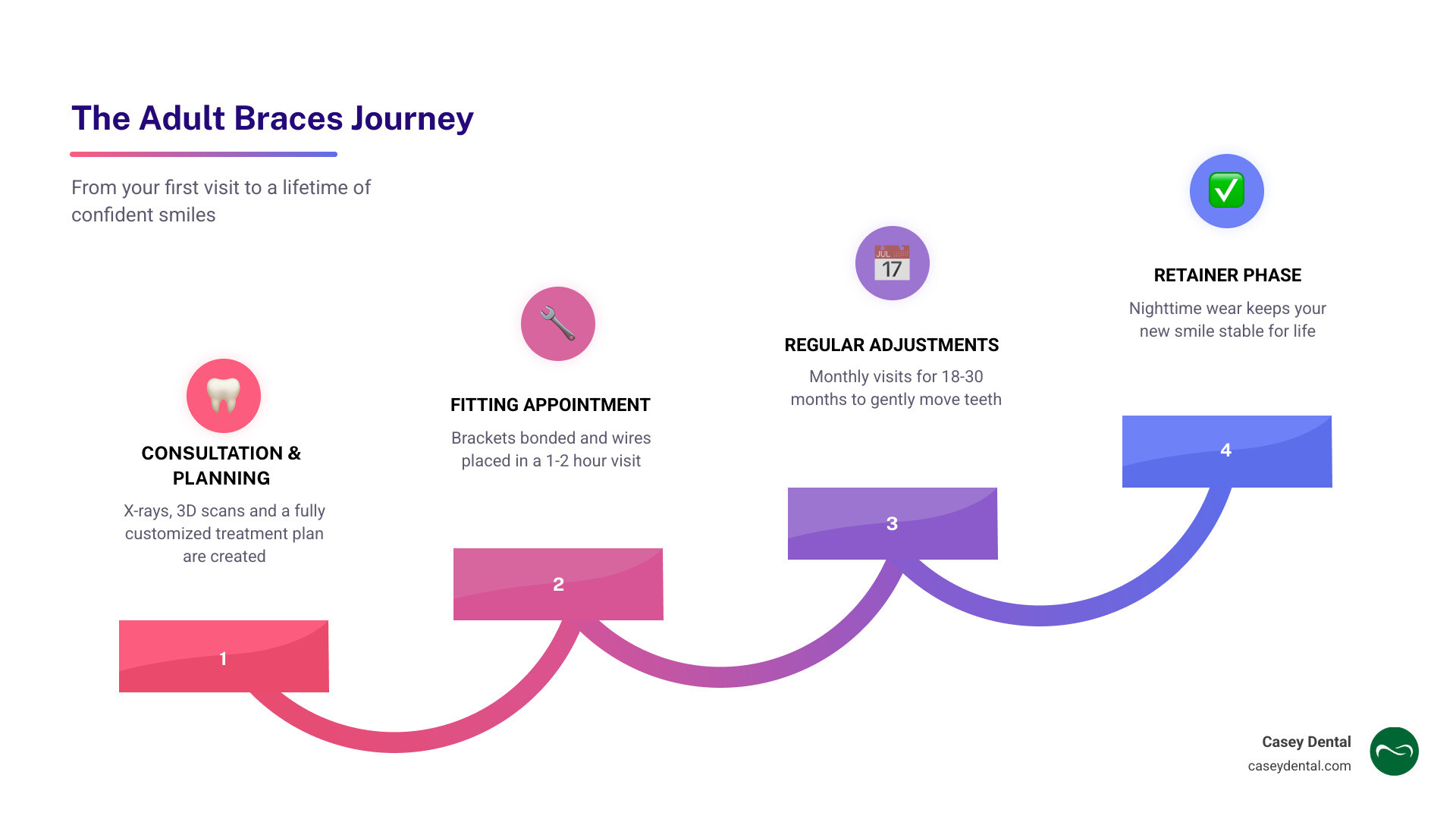
The journey begins with an initial consultation. This is your time to ask questions and for us to get a clear picture of your oral health. Knowing When to See an Orthodontist is the first step toward a healthier bite. During this visit, we perform a thorough exam of your teeth and gums. We use X-rays and cutting-edge 3D imaging to map out exactly how your teeth need to move.
Once we have a plan, the fitting appointment is scheduled. This usually takes between one and two hours. If you are getting traditional or ceramic braces, we will clean and dry your teeth before applying a special bonding agent to attach the brackets. We then thread the archwire through the brackets and secure it. In some cases, we may apply spacers (small rubber rings) between your back teeth a week prior to create enough room for orthodontic bands.
Braces for Adults: What to Expect During the First Week
The first week is the biggest adjustment period. You might experience increased saliva production immediately after placement — don’t worry, your mouth usually adjusts within 20 to 30 minutes! You will likely feel a sensation of deep pressure or “tightness.” This is a sign that the braces are doing their job.
To manage initial soreness, we recommend over-the-counter pain relief like ibuprofen. You’ll also want to keep plenty of orthodontic wax on hand. If a bracket or wire starts to chafe the inside of your cheek, simply roll a small piece of wax and press it over the irritating part. For more details on the early stages, see Everything You Need to Know About Teeth Braces.

During this first week, stick to a soft food diet. Your teeth will be tender, so foods like yogurt, mashed potatoes, scrambled eggs, and smoothies will be your best friends. You might also notice a slight change in your speech, especially if you have lingual braces or aligners, but this usually resolves as your tongue learns to navigate the new appliances.
Daily Life and Maintenance with Adult Braces
Living with braces requires a few tweaks to your daily routine, but they quickly become second nature. The biggest change is your brushing routine. You should brush after every meal and snack to ensure no food is trapped against your teeth.
Flossing becomes a bit of a “craft project” with wires in the way. We recommend using floss threaders or interdental brushes to get underneath the archwire. Many of our patients at Casey Dental find that a water flosser is a life-changer, making it much easier to flush out debris from hard-to-reach spots. For a general overview of living with braces, visit our page on Dental Braces.
Food restrictions are another reality. You’ll need to avoid:
- Sticky foods: Caramel, taffy, and gum.
- Hard foods: Ice, nuts, and hard candies.
- Crunchy foods: Popcorn and hard pretzels.
- Whole fruits: Don’t bite directly into an apple or corn on the cob; cut them into small, bite-sized pieces instead.
While you might worry about your professional image, most adults find that colleagues barely notice their braces or are even inspired to ask about their own treatment. If you’re curious about how this differs from younger patients, check out Braces for Teens: What Parents and Teens Should Know.
Braces for Adults: What to Expect for Long-Term Results
How long will you be in treatment? On average, adult orthodontic treatment lasts between 18 and 30 months. Because adult bone density is higher and our jaws have stopped growing, teeth may move slightly slower than they do in teenagers. However, modern technologies like Propel can sometimes speed up bone remodeling and reduce treatment time.
Once the braces come off, the “retention phase” begins. This is arguably the most important part of your journey. To maintain your straight, healthy smile, you must wear a retainer. Initially, you may wear it full-time, eventually transitioning to nighttime wear indefinitely. Without a retainer, your teeth will naturally want to shift back to their original positions.
Many adults also choose to do post-treatment whitening to really make their new smile pop. We can discuss these options as you get closer to your “de-banding” date.
Investment and Special Considerations for Mature Patients
Understanding the Cost of Braces is a major part of the decision-making process. For adults, the cost typically ranges from $3,000 to $8,000, depending on the complexity of the case and the type of braces chosen.
Does Insurance Cover Braces? What You Need to Know Before Starting Treatment is a common concern. While many plans cover orthodontics for children, adult coverage varies. Some plans offer a lifetime maximum benefit (often between $1,000 and $2,500), while others may only cover treatment if it is deemed medically necessary. We can help you navigate these details during your consultation. For more on the financial side, read Understanding Braces Cost: Factors That Influence Orthodontic Treatment.
Adults also have unique physiological considerations. We must ensure your gum health and bone support are strong before starting. If you have a history of gum disease, we may coordinate with a periodontist to ensure your bone can handle the pressure of moving teeth. We also look at existing crowns or bridges; while we can bond brackets to crowns, it requires a different technique.
Another rare but important consideration is root resorption — a slight shortening of the tooth roots that can occur during movement. We monitor this closely with periodic X-rays throughout your treatment.
Frequently Asked Questions about Adult Braces
How long do adult braces take on average?
Most adults are in braces for 12 to 30 months. The exact duration depends on the complexity of your bite, how far the teeth need to travel, and your compliance (especially with aligners or rubber bands). Because adult bone remodeling happens more slowly than in children, you should expect the process to take a few months longer than it might for a teen.
Are braces more painful for adults than for teenagers?
Not necessarily. The “pain” is usually described as a deep pressure or dull ache, particularly after the initial fitting or a tightening appointment. Modern wires are designed to apply lighter, more constant forces, which makes the process much more comfortable than the braces of twenty years ago. Most discomfort is easily managed with soft foods and over-the-counter pain relievers.
Can I get braces if I have missing teeth or dental implants?
Yes! In fact, braces are often used to create the correct amount of space before a dental implant or bridge is placed. If you already have a dental implant, it cannot be moved because it is fused to the bone. However, we can use the implant as a stable “anchor” to move the other teeth around it.
Conclusion
Deciding to improve your smile as an adult is a significant step toward better oral health and increased self-confidence. At Casey Dental, we provide expert orthodontic guidance tailored to the unique needs of mature patients, ensuring your journey to a straighter smile is as comfortable as possible. Whether you need a routine adjustment or require emergency care for a broken bracket or wire, our team is here to support you. To maintain your results and keep your braces clean, explore our recommended oral hygiene products at our patient store. Contact us today to schedule your consultation and begin your transformation in Pittston, PA.