Real All on 4 Implants Before and After Case Studies and Smile Transformations
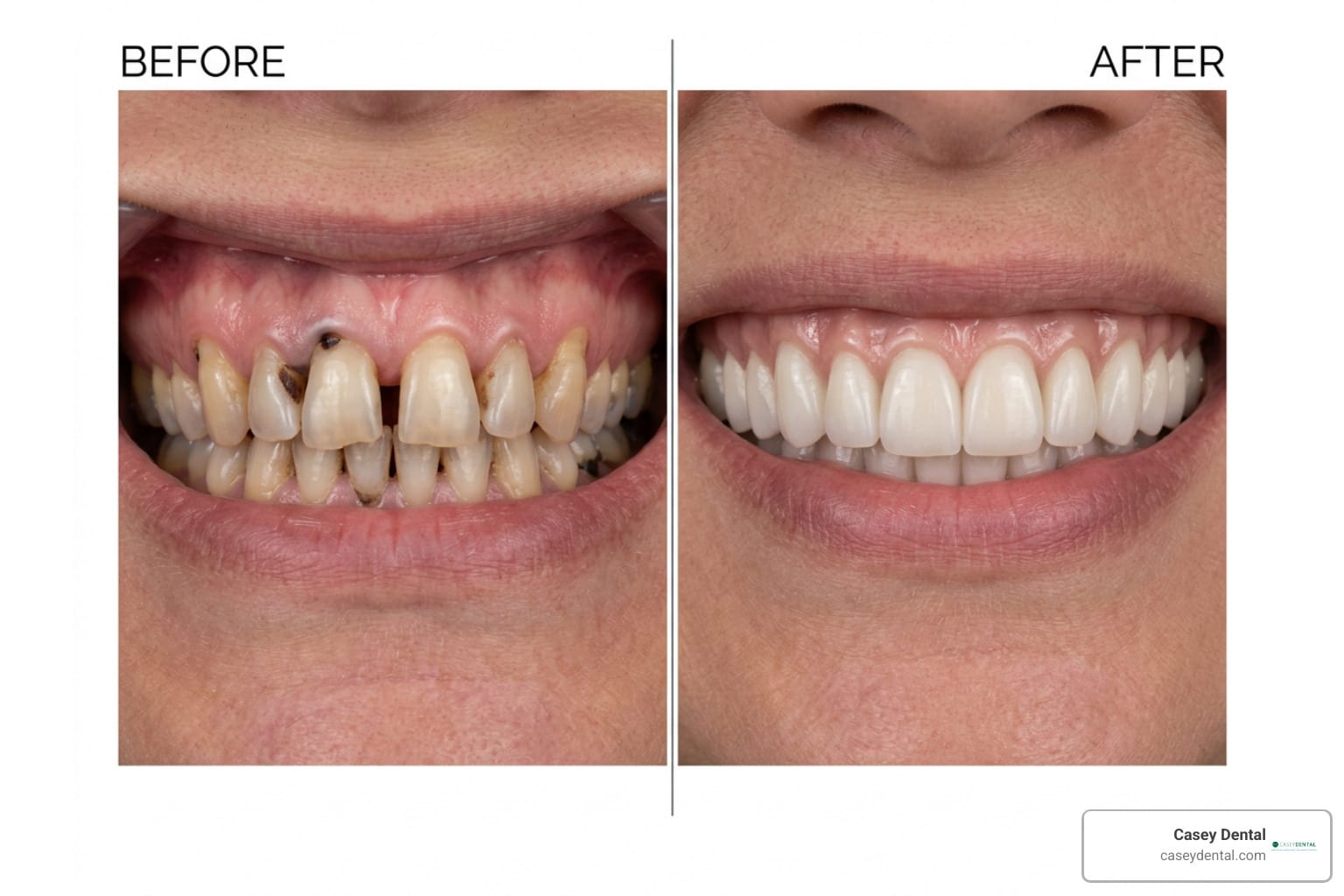
Real all on 4 implants before and after transformations take patients from severe decay, failing teeth, and collapsed bites to a fully functional, fixed smile within 24 to 48 hours, followed by a durable, permanent custom zirconia arch once healed. When people begin researching full-arch rehabilitation, they often arrive at our practice feeling exhausted by endless dental appointments, chronic pain, or embarrassing tooth loss. Understanding what are all on 4 dental implants is the first step toward reclaiming functional oral health. In practical terms, this technique uses four strategically placed titanium posts to secure an entire upper or lower bridge of teeth, bypassing the need to replace each root individually as you would with single tooth implants.
Patients facing advanced decay, severe periodontitis, or fractured bridge work often wonder what immediate loading really looks like. Let us walk through how these transformations happen in real clinical scenarios.
Case Study 1: Failing Upper Teeth to a Fixed Zirconia Arch
A patient in her early 50s presented with extensive wear on her front teeth and missing posterior molars. Because she lacked back teeth to absorb heavy chewing forces, her front natural teeth suffered structural attrition, micro-fracturing, and enamel chipping. Compounding the problem, her upper teeth had begun hyper-erupting—drifting downward into empty lower spaces—which completely disrupted her bite plane.
We removed the unsalvageable upper teeth and placed four implants into the maxillary arch. The posterior implants were tilted to maximize bone contact without invading the sinus cavities. Within 48 hours, she received a fixed transitional acrylic prosthesis that restored her ability to smile openly. After a three-month healing period, we delivered her definitive bridge: a custom, computer-milled monolithic zirconia restoration that matched her natural lip line and gave her full chewing function.
Case Study 2: Periodontal Bone Loss and Severe Bite Collapse
Another common presentation involves generalized severe periodontitis. One patient came to us with extreme tooth mobility, deep gum pockets, and substantial mandibular bone loss. Eating solid food had become impossible, and his lower jaw had receded, causing noticeable facial collapse.
For this case, we utilized bicortical stabilization—anchoring the implants securely into the dense cortical plates of the jawbone to achieve the primary stability required for immediate provisional loading. On the day of surgery, we extracted the loose teeth, placed the implants, and attached a fixed temporary bridge. Rather than enduring months with a loose removable denture, he walked out with non-removable teeth. Once osseointegration was complete, his final bridge permanently restored his vertical facial height and bite stability.
All on 4 Implants Before and After Radiographic Analysis: What X-Rays Reveal
Cosmetic photos show the visible smile, but panoramic X-rays and 3D CBCT scans tell the true clinical story.
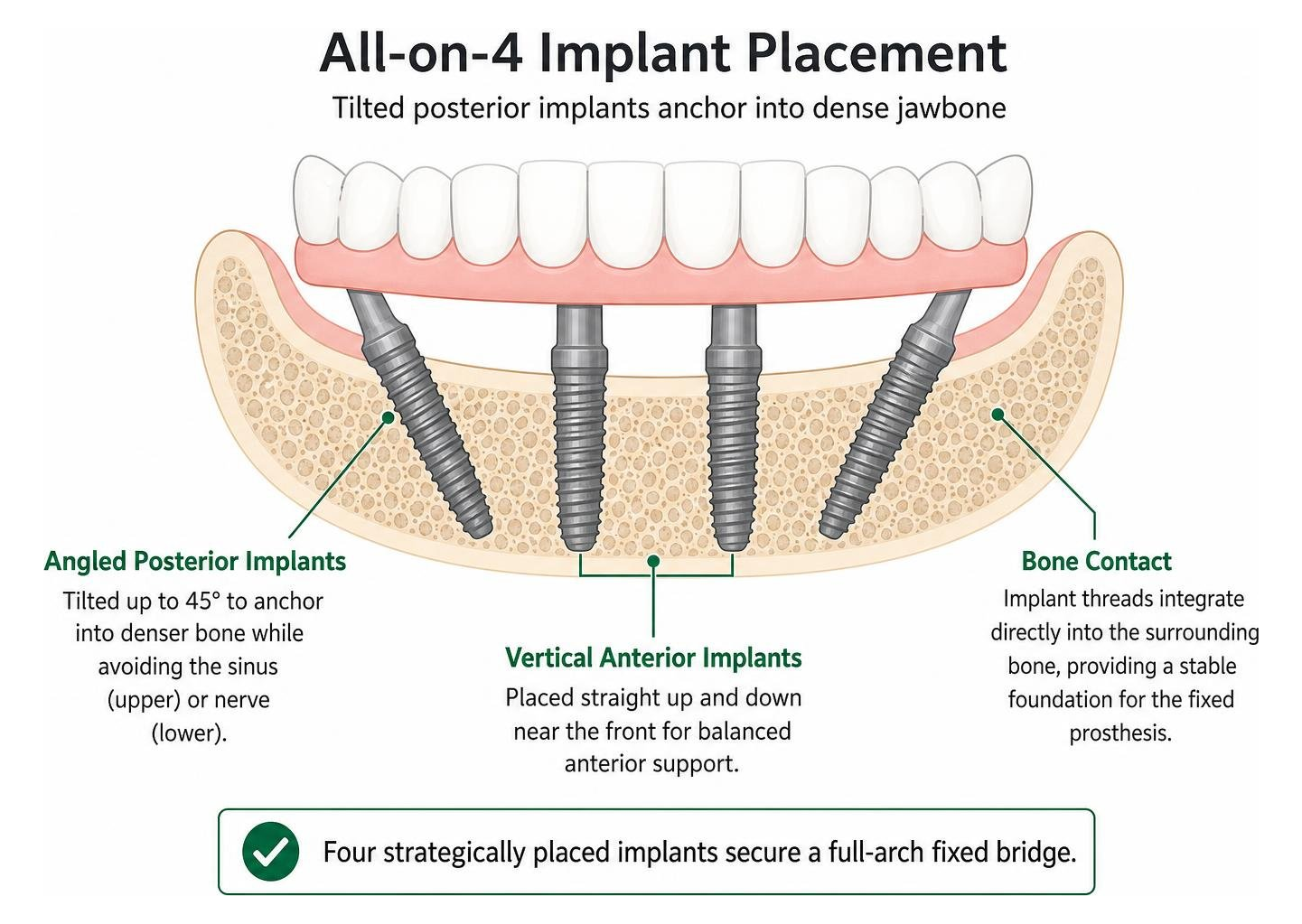
When you look at a full-arch implant X-ray, you should notice:
- Angled Posterior Implants: The two posterior posts are angled up to 45 degrees, allowing us to anchor into denser anterior bone while steering clear of the maxillary sinus in the upper jaw and the mental nerve in the lower jaw.
- Vertical Anterior Implants: Two anterior implants sit straight up and down near the front of the jaw to provide balanced anterior support.
- Bone Contact: You can see how the titanium threads physically integrate directly into the surrounding bone volume, providing the foundation for a published survival rate of roughly 95% to 99% over 5 to 10 years.
How to Critically Evaluate Before-and-After Galleries
Online smile galleries are everywhere, but not all transformation photos are created equal. As we explain in a practical guide to all on 4 implants, prospective patients should approach aesthetic galleries with a critical, educated eye to separate marketing hype from legitimate clinical expertise.
You can also review clinical documentation, such as the All-on-4 Before and After: Real Patient Photos (2026) guide, to see how clinical teams document real patient journeys.
Clinical Signs of Genuine All on 4 Implants Before and After Outcomes
When assessing clinical galleries, look closely at these anatomical indicators:
- Gumline Transition & Emergence Profile: The transition where the prosthetic meets the soft tissue should look natural, without unnatural bulkiness or deep dark crevices where food can easily pack.
- Natural Translucency vs. Opaque Chalkiness: Real enamel is slightly translucent at the edges. High-quality permanent teeth mimic this natural depth of shade rather than looking like an unnatural, flat white block.
- Buccal Corridors & Midline: A properly designed arch fills the smile naturally without leaving large dark gaps in the corners of the mouth (buccal corridors), while keeping the central midline aligned with the patient’s facial symmetry.
- Consistent Lighting & Retraction: Genuine cases use consistent, unretouched angles and lighting between the “before” and “after” images rather than using harsh shadows on the before shot and soft studio filters on the after shot.
Provisional Temporary Teeth vs. Final Permanent Bridges
One of the biggest misunderstandings in full-arch dentistry involves the difference between immediate temporary teeth and the final restoration.
- The Immediate Provisional (Day 1 to Month 3–6): Attached within a 24- to 72-hour window post-surgery, this fixed bridge is typically made of high-density acrylic resin. It is designed to be lightweight to protect the healing implants while shielding them from excessive chewing stress during initial osseointegration.
- The Definitive Permanent Bridge: Fabricated after the implants have fully fused with the jawbone and the gums have completely settled. This bridge is crafted from ultra-durable materials like monolithic zirconia or porcelain fused to a custom titanium framework, offering lifetime strength and stain resistance.
Facial and Structural Changes: Beyond the Smile Gallery

A full-arch restoration does far more than replace missing enamel; it fundamentally rebuilds the structural architecture of the lower face. When teeth are lost, the alveolar bone naturally resorbs over time. This causes the distance between the nose and the chin to shrink—a condition known clinically as collapsed vertical dimension of occlusion (VDO).
Restoring Lip Support and Vertical Dimension
When the bite collapses, deep creases form around the mouth (nasolabial folds), the corners of the lips turn downward, and the lips themselves look thin and unsupported. Patients often tell us that friends ask if they had plastic surgery after their arches are restored.
By precisely calculating the ideal vertical dimension during digital planning, we build the prosthetic bridge to restore natural lip projection and cheek support. This smooths out premature facial wrinkling and brings the entire facial profile back into balanced harmony.
Comparing All-on-4 and All-on-6 Full Arch Solutions
While four implants provide exceptional stability for many patients, certain anatomical situations call for six implants per arch. Clinical case documentation and advanced 3D imaging illustrate how individual anatomical factors dictate the number of posts needed.
Depending on whether a patient chooses conventional implant supported dentures or a fixed full-arch restoration, selecting the right number of dental implants depends entirely on individual biomechanics:
| Clinical Feature | All-on-4 Protocol | All-on-6 Protocol |
|---|---|---|
| Primary Indication | Moderate to severe bone loss; avoids bone grafting | Ample bone volume; wide jaw arches |
| Posterior Support | Angled implants up to 45° bypass sinus/nerves | Straight and angled implants provide extra load distribution |
| Bite Force Tolerance | Excellent for standard to moderate bite forces | Ideal for heavy bruxers (teeth grinders) and strong jaw muscles |
| Grafting Requirement | Rarely requires bone grafting | May require targeted bone augmentation |
| Prosthetic Type | Fixed monolithic zirconia or acrylic hybrid bridge | Fixed monolithic zirconia or porcelain bridge |
The Honest Healing Timeline and Investment Considerations
While before-and-after photos show the rewarding finish line, patients must understand the biological journey required to get there. Knowing how long do dental implants last depends heavily on strict post-operative compliance and dedicated long-term care.
During the first 2 to 3 weeks following surgery, swelling and mild bruising are completely normal. Patients must adhere strictly to a soft-food diet (think eggs, yogurt, flaked fish, and smoothies) to prevent excessive micromotion on the implants while early bone bridging takes place. Maintaining exceptional hygiene under the bridge using specialized tools—many of which can be found in our patient oral care store—is essential to prevent peri-implant bacterial buildup.
Materials Breakdown: Acrylic Hybrids vs Monolithic Zirconia
The materials chosen for your full-arch bridge dictate both aesthetics and long-term durability:
- Acrylic-Titanium Hybrids: Feature an underlying titanium bar wrapped in pink acrylic resin with denture-grade teeth. While functional and cost-effective, acrylic is porous, prone to staining over time, and can suffer tooth chipping under heavy biting forces, often requiring maintenance every 5 to 10 years.
- Monolithic Zirconia: Milled from a solid block of ultra-strong zirconium oxide ceramic. Zirconia is non-porous, virtually impervious to chipping or staining, highly biocompatible with gum tissue, and offers a natural, lifelike translucency that lasts for decades.
Global Cost Breakdown and Inclusive Treatment Costs
Understanding the true cost of dental implants and how much are all on four dental implants requires looking at what a treatment quote actually covers.
Globally, treatment pricing varies widely:
- United States: Comprehensive, high-end private care generally ranges from $25,000 to $50,000+ per arch ($50,000 to $100,000+ for a full mouth), covering 3D CBCT imaging, guided surgery, premium titanium implants, provisional prosthetics, final custom zirconia bridges, and dedicated post-surgical warranties.
- International Packages: Dental tourism packages in regions such as Turkey start around €3,500 per jaw, while full-arch care in China is marketed from approximately $5,599 per arch ($11,200 for full mouth).
While travel packages can seem tempting on paper, patients must carefully weigh the hidden costs: travel expenses, lack of local follow-up care if a component loosens, and the difficulty of managing surgical revisions or complications once back home.
Frequently Asked Questions About All-on-4 Implants
How long does it take to see the final All-on-4 results?
You will walk out with fixed, functional temporary teeth within 24 to 72 hours of your surgical appointment. However, the final definitive bridge is placed after an osseointegration period of 3 to 6 months, ensuring your jawbone has fully fused to the implant posts and gum contours have stabilized.
Do All-on-4 dental implants look and feel like natural teeth?
Yes. Because the bridge is securely anchored by titanium posts rather than resting on top of the gums, it does not slip, click, or require messy adhesives. Additionally, upper All-on-4 bridges do not cover the roof of your mouth, restoring full taste sensation and natural speech mechanics.
What are the main risks and hygiene demands not shown in photos?
Before-and-after galleries do not show the diligent daily maintenance required to keep implants healthy. You must clean beneath the bridge daily using a water flosser, interdental brushes, or specialized floss to prevent peri-implantitis (inflammation and bone loss around implants). Routine professional cleanings every 6 months are vital to ensure lifetime success.
Conclusion
A true full-arch smile makeover is a life-changing health investment that restores chewing power, halts progressive bone deterioration, and rebuilds your facial balance and self-confidence. If you are struggling with failing bridge work, extensive tooth decay, or loose dentures, scheduling a comprehensive consultation with 3D CBCT diagnostic imaging is the first step toward determining whether all on 4 implants are right for your needs.
At Casey Dental, our experienced team provides award-winning, comprehensive dental care in Pittston, PA, utilizing cutting-edge surgical technology focused entirely on your comfort. Whether you need a customized full-arch restoration plan, routine preventative maintenance, or prompt emergency dental care, contact Casey Dental today to begin your journey toward a healthy, lasting smile.