When Traditional Dentures Let You Down: What to Know About Implant Supported Dentures
Implant supported dentures are a modern tooth replacement solution that anchors a full set of prosthetic teeth directly to your jawbone using titanium implant posts — instead of resting loosely on your gums like traditional dentures.
Here’s a quick overview of what makes them different:
- How they work: 2 to 6 titanium implants are placed in the jawbone, and a custom denture snaps or locks onto them
- Two main types: Removable (snap-in) dentures you can take out daily, or fixed (hybrid) dentures only a dentist can remove
- Key benefit: Far more stable than traditional dentures — no slipping while eating or speaking
- Jawbone health: Unlike traditional dentures, implants stimulate the bone and help prevent bone loss
- Timeline: The full process takes roughly 5 to 8 months from consultation to final fitting
- Lifespan: The implants themselves can last a lifetime; the overdenture typically needs replacement every 15 to 20 years
- Cost: Generally ranges from $5,000 to $10,000 or more, depending on the number of implants needed
If you’ve ever struggled with dentures that shift, slip, or cause sore spots, you’re not alone. Many people find that traditional dentures make everyday moments — like eating at a restaurant or laughing with family — feel stressful and uncertain. Implant supported dentures were designed to solve exactly that problem.
I’m Dr. Shawn Casey, founder of Casey Dental in Pittston, PA, and a Doctor of Dental Medicine with over 30 years of experience in restorative care, including implant supported dentures and guided implant surgery. In this guide, I’ll walk you through everything you need to know — from candidacy and cost to the step-by-step procedure and long-term care.
What Are Implant Supported Dentures?
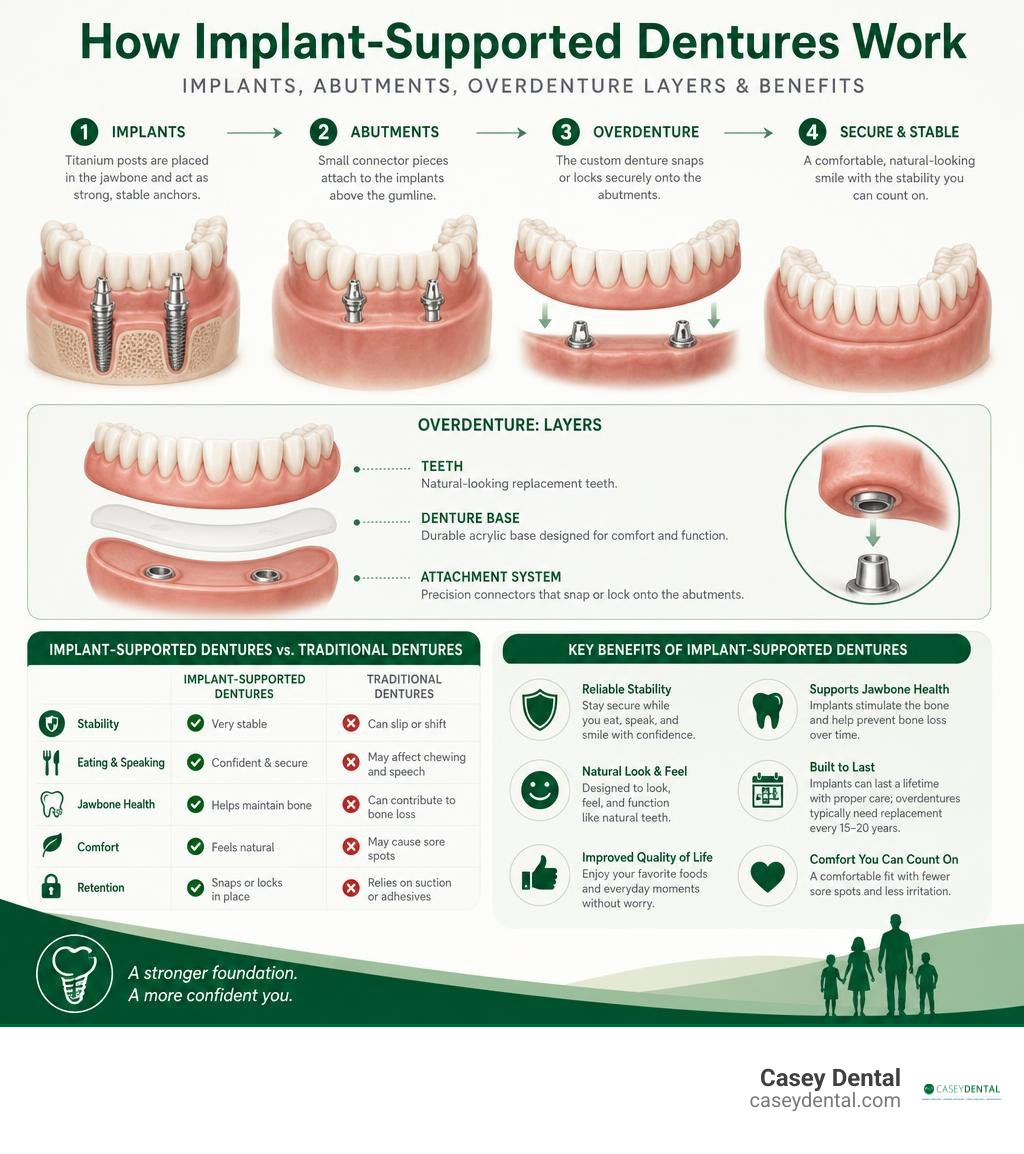
To understand how implant supported dentures work, it helps to look at the mechanics of a natural tooth. A natural tooth has a crown (the visible part) and a root anchored in the jawbone. Traditional dentures only replace the crown, resting on top of the gums and relying on suction, gravity, or messy adhesives to stay in place.
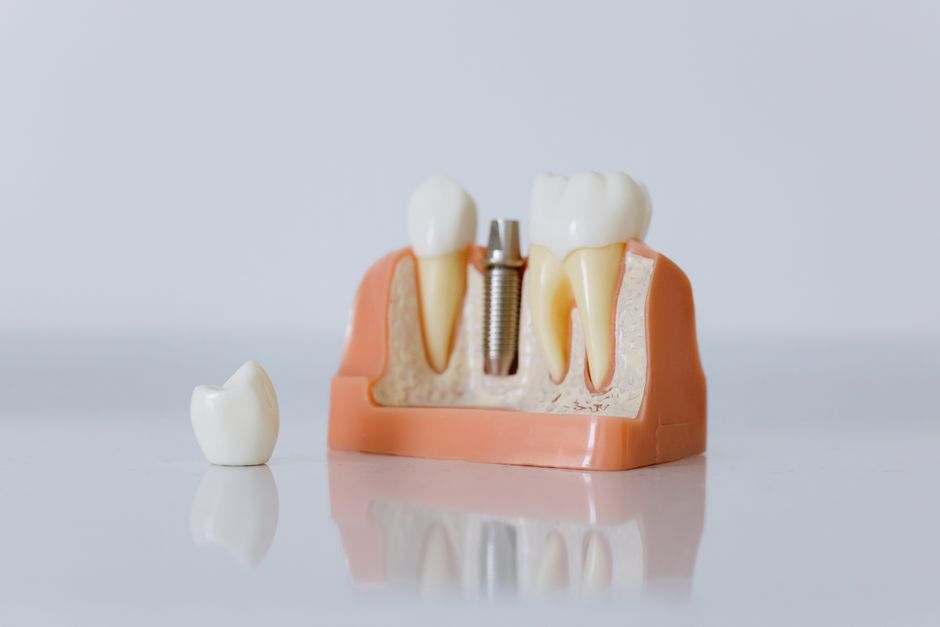
An implant-supported overdenture, however, replaces both the crowns and the roots. It is a state-of-the-art restorative system that anchors a custom-made denture directly to medical-grade titanium posts surgically placed into your jawbone. Because titanium is biocompatible, it undergoes a natural process called osseointegration, where the jawbone physically fuses with the metal. This fusion mimics natural tooth roots, providing unmatched stability and active jawbone stimulation to prevent the bone resorption (shrinkage) that naturally occurs after tooth loss.
At Casey Dental, we regularly help patients upgrade from sliding plates to stable, life-changing restorations. You can learn more about our specific approach on our dedicated implant supported dentures page.
For a broader clinical perspective, the Cleveland Clinic provides an excellent breakdown of this restorative treatment in their resource on Implant Supported Dentures: Process, Benefits & Care.
To see how these systems stack up against conventional options, let’s compare them side-by-side:
| Feature | Traditional Dentures | Implant Supported Dentures |
|---|---|---|
| Primary Support | Rest on the gums, secured by suction or adhesives | Anchored directly to titanium dental implants |
| Stability & Fit | Can slip, click, or shift while eating and speaking | Locked firmly in place; no movement or shifting |
| Chewing Power | Restricts hard or sticky foods; roughly 20% of natural power | Restores nearly full chewing capacity; eat hard foods safely |
| Bone Preservation | Accelerates jawbone loss due to constant gum pressure | Actively preserves and stimulates jawbone density |
| Adhesives Needed | Yes, frequently required | No, never |
| Average Lifespan | Must be replaced or relined every 5 to 7 years | Implants can last a lifetime; overdenture lasts 15–20 years |
Fixed vs. Removable Implant Supported Dentures
When exploring this life-changing treatment, you will choose between two primary configurations: removable or fixed.
- Removable Implant-Supported Dentures (Snap-In Dentures): Often called snap-in or snap-on dentures, these overdentures attach to the implants using specialized attachments (typically ball-retained or bar-retained systems). A bar-retained system uses a thin metal bar that follows the curve of your jaw, attaching to the implants, while the denture snaps over the bar. A ball-retained system utilizes ball-shaped attachments on the implants that fit into matching sockets on the denture. You can easily “snap” these out at night to clean them and soak them.
- Fixed Implant-Supported Dentures (Hybrid Dentures): These are permanently screwed onto the implants. Only a dental professional can remove them for deep cleaning during your regular check-ups. They are exceptionally low-profile, do not cover the roof of your mouth, and look, feel, and function exactly like natural teeth.
A highly popular type of fixed restoration is the All-on-4 method. If you are wondering what are all on 4 dental implants, it is a specialized technique that replaces an entire arch of missing teeth using exactly four strategically angled dental implants. This method often eliminates the need for bone grafting, making All On 4 Implants an efficient, stable, and highly sought-after alternative for full-mouth reconstruction.
Who is a Candidate for Implant Supported Dentures?
While implant-supported prosthetics are a solution, they are not suitable for everyone. During your initial consultation at Casey Dental, we will thoroughly evaluate several key candidacy factors:
- Jawbone Density: Because the implants rely on the bone for support, you must have adequate bone height and width. If you have been missing teeth for a long time, you may have experienced bone deterioration. However, if you are concerned, you should know that we can often perform a bone graft to rebuild the area. For a deeper look at your options, read our guide on whether can you get dental implants with severe bone loss.
- Gum and Oral Health: Your gums must be entirely free of periodontal disease. Any active infections must be fully treated before surgical placement.
- Overall Systemic Health: Since placing implants is a surgical procedure, you should be in good general health. Conditions like uncontrolled diabetes or autoimmune disorders can hinder the healing process.
- Smoking Status: Smoking restricts blood flow to the gums and bone, which significantly increases the risk of implant failure. We strongly advise patients to quit smoking at least one week before surgery and abstain for at least two months afterward to ensure proper healing.

The Step-by-Step Treatment Process
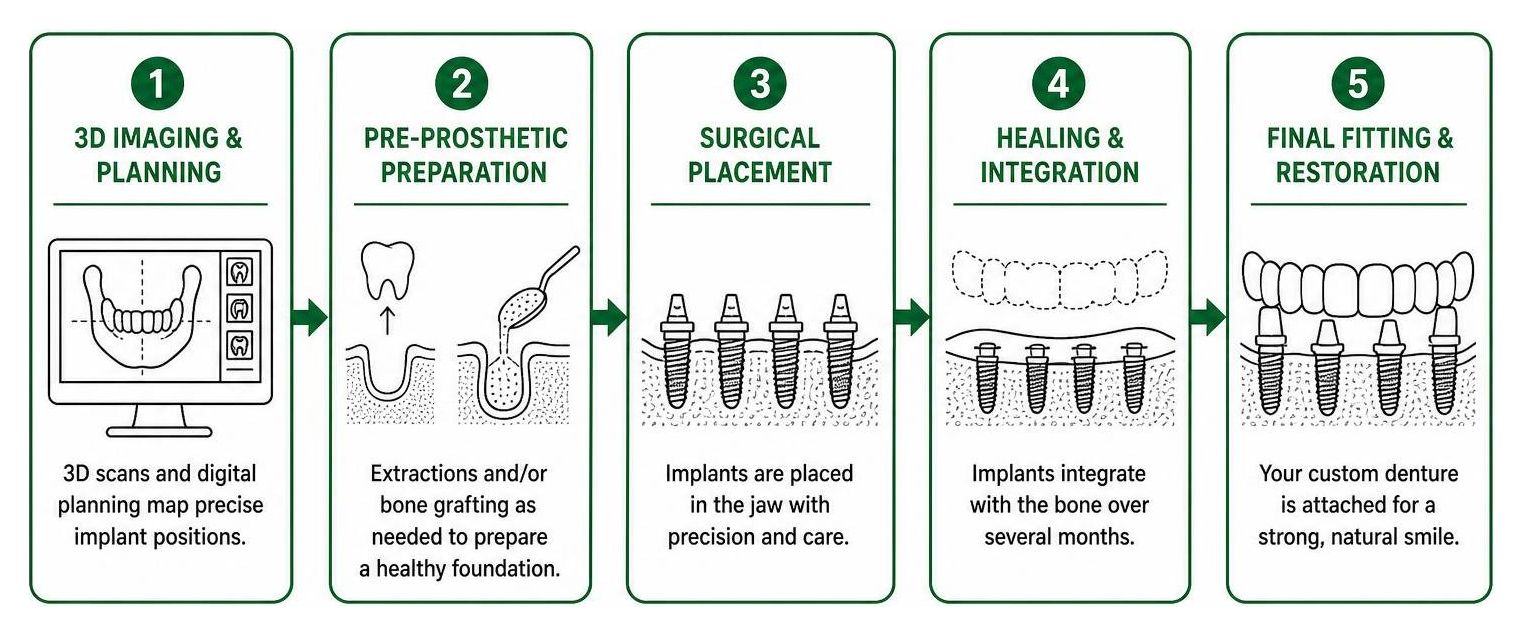
Transforming your smile with implant supported dentures is a multi-step journey that requires precision, patience, and expert planning. At Casey Dental, we walk with you through every phase to ensure your comfort and peace of mind.
Phase 1: Consultation and 3D Imaging
Every successful transformation starts with a comprehensive evaluation. We utilize state-of-the-art 3D Cone Beam Computed Tomography (CBCT) scans to capture highly detailed, three-dimensional images of your jawbone, nerve pathways, and surrounding tissues. This advanced imaging allows us to carefully plan the exact depth, angle, and position of each implant. By using guided implant surgery, we can perform the procedure with incredible accuracy, minimizing surgical time and post-operative discomfort.
Phase 2: Pre-Prosthetic Preparation
If you have remaining damaged teeth that need to be extracted, or if you require bone grafting to bolster your jawbone, we perform these preparatory steps first. Depending on the complexity of your case, we can perform these minor procedures under conscious sedation or comprehensive sedation dentistry to keep you completely relaxed and pain-free. Our experienced team handles all aspects of oral surgery in-house, ensuring a seamless, comfortable experience.
Surgical Placement and Osseointegration
Once your jawbone is fully prepared, we move on to the implant placement surgery. During this step, we gently place the titanium posts into your jawbone.
After the implants are placed, the critical phase of osseointegration begins. This is the period where your bone cells grow and attach directly to the titanium surface.
- Healing Timeline: It typically takes about three to six months for the implants to fully integrate and fuse with your jawbone.
- Temporary Restorations: You won’t have to go toothless during this time! We will provide you with a temporary “healing denture.” This temporary appliance is designed to sit lightly over your gums without putting direct pressure on the healing implants, protecting them while they fuse.
- Surgical Recovery: While complete bone integration takes a few months, your initial soft tissue healing is much faster. Most patients feel back to normal within a week, and in most instances, you can return to routine activities in two to three days after dental implant surgery. We recommend avoiding strenuous exercise for at least 48 hours to minimize any risk of bleeding or swelling.
To understand the long-term predictability of this treatment, a look at clinical data is highly reassuring. Scientific research on implant survival rates suggests that implant-supported systems have an exceptional 20-year implant survival rate of up to 92.5%, making them one of the most reliable procedures in modern dentistry.
Fitting the Final Prosthesis
Once osseointegration is complete, you will return to our Pittston office for the final, exciting phase. We will attach small connector pieces, called abutments, to your implants. We then take precise digital impressions of your mouth to design your custom overdenture.
Our laboratory partners craft your prosthesis to match your ideal bite alignment, facial structure, and aesthetic goals. When the final denture is ready, we will securely attach it to your implants, adjust the fit, and ensure your bite is perfectly balanced.

Understanding the Cost of Implant-Supported Dentures
One of the most common questions our patients ask is: What is the financial investment?
Because every mouth is unique, the total cost of implant supported dentures varies based on several factors, including the number of implants required, the need for preparatory extractions or bone grafting, and the type of final denture (fixed vs. removable) you choose.
Generally, snap-in dentures cost anywhere from $5,000 to $10,000 per arch. If you opt for a fully fixed hybrid or All-on-4 system, the cost may be higher due to the increased complexity and materials used.
To help you navigate your options, we have compiled several detailed financial guides. You can explore our breakdowns of how much are implant dentures or view localized pricing trends in our article on dental implant cost in Luzerne County.
We believe that high-quality dentistry should be accessible to everyone in our community. If you are working within a specific budget, we highly recommend checking out the ultimate guide to affordable dental implants in pennsylvania as well as our practical tips on finding the best affordable dental implants pa on a budget.
While dental insurance and Medicare rarely cover the entire cost of implant surgery, many plans will cover a portion of the preparatory extractions or the custom overdenture itself. Our experienced financial coordinators at Casey Dental will work directly with your insurance provider to maximize your benefits and set up flexible, low-interest financing plans that fit your monthly budget.
Long-Term Care, Maintenance, and Lifespan
Taking care of your new smile is straightforward, but it does require commitment. Proper maintenance ensures that both your implants and your prosthetic teeth stay clean, healthy, and functional for decades.
- For Removable Overdentures: You must take your snap-in denture out at least twice a day. Clean the denture thoroughly using a soft-bristled brush and a nonabrasive denture cleaner (regular toothpaste can scratch the acrylic, creating tiny pockets where bacteria thrive). Gently brush your gums, tongue, and the implant attachments in your mouth with a soft toothbrush. Soak your dentures in water or a mild denture solution overnight to keep them from warping.
- For Fixed Hybrid Dentures: Because you cannot remove these yourself, you will brush them in your mouth just like natural teeth. Use a soft-bristled toothbrush and nonabrasive toothpaste. Additionally, you should use specialized cleaning tools, such as floss threaders, water flossers, or interproximal (interdental) brushes, to clean thoroughly underneath the denture and around the implant posts where plaque can gather.
- Preventing Peri-Implantitis: Just like natural teeth can suffer from gum disease, implants can develop a condition called peri-implantitis if plaque is allowed to build up. This is an inflammatory condition that affects the gums and bone surrounding the implant, which can lead to implant failure if left untreated.
To dive deeper into the clinical standards for keeping your prosthesis pristine, you can review this Scientific research on overdenture maintenance, which highlights the best hygienic practices for preventing complications.
Lifespan Expectations
With proper care, routine professional cleanings, and regular check-ups every 3 to 6 months, your medical-grade titanium dental implants can easily last a lifetime. However, because the overdenture itself is subjected to daily chewing forces, it will experience normal wear and tear. You can expect a high-quality overdenture to last between 15 to 20 years before needing to be replaced or rebuilt, while some studies suggest that entry-level snap-in options may need replacement or clinical adjustments every 5 to 10 years.
Frequently Asked Questions about Implant Dentures
How many dental implants are needed for implant-supported dentures?
Typically, 2 to 6 implants are needed per jaw for snap-in dentures. The lower jaw often requires fewer implants (usually 2 to 4) because the bone is naturally denser, while the upper jaw generally requires more (4 to 6) due to softer bone structure. If you are looking for a fixed, full-arch solution, you can learn more in a practical guide to all on 4 implants or explore the associated costs in our guide to how much are all on four dental implants.
How long do implant-supported dentures last?
While the underlying titanium implants are designed to last a lifetime, the prosthetic overdenture itself needs replacement every 15 to 20 years. Some research suggests that if you have a basic two- or four-implant snap-in configuration, the acrylic overdenture may survive for 5 to 10 years before needing to be replaced or refitted due to wear on the plastic snap attachments.
Can implant-supported dentures be removed?
Yes, but it depends entirely on the type you choose. Removable snap-on dentures are designed to be taken out daily by the patient for cleaning and sleeping. Fixed hybrid dentures are securely screwed in place and cannot be removed by the patient; they are only removed by a dentist during your routine maintenance visits.
Conclusion
Losing your teeth doesn’t mean you have to lose your quality of life, your confidence, or your ability to enjoy your favorite meals. Whether you are currently struggling with loose, shifting traditional plates or are facing extensive tooth loss, implant supported dentures offer a stable, natural-looking, and health-preserving solution that can truly transform your daily life.
At Casey Dental in Pittston, PA, we are proud to offer comprehensive, state-of-the-art restorative care under one roof. From your initial 3D imaging and guided surgery to the final, beautiful fitting of your custom overdenture, our warm and experienced team is dedicated to keeping you comfortable every step of the way. If you ever experience a dental emergency, such as a damaged denture or sudden discomfort, we are always here to provide prompt, compassionate emergency care.
Ready to take the first step toward a secure, worry-free smile? Contact us at Casey Dental today to schedule your personalized consultation. Don’t forget to visit our patient store to explore high-quality oral hygiene products designed to keep your new smile clean, bright, and healthy for a lifetime!