Comprehensive Dental Implants vs Bridges Long Term Comparison
When evaluating modern restorative dentistry, comparing dental implants and traditional tooth-supported bridges requires looking beyond the initial procedure. Both treatments successfully restore bite function and aesthetics, but their structural lifespans, biological footprints, and biomechanical stability differ considerably over decades.
| Feature / Metric | Dental Implant (Single Tooth) | Traditional Fixed Bridge (3-Unit) |
|---|---|---|
| Average Expected Lifespan | 20–30+ years (often a lifetime for fixture) | 10–15 years (often 5–7 years if hygiene lapses) |
| 10-Year Survival Rate | 94% – 98% | 85% – 92% |
| 20-Year Survival Rate | ~80% (4 out of 5 remain fully functional) | Significant decline; multiple replacements required |
| Impact on Adjacent Teeth | Zero structural impact; completely independent | Enamel removal and irreversible reshaping of 2 teeth |
| Alveolar Bone Preservation | Halts bone loss via continuous mechanical loading | Does not stimulate bone; ridge resorbs slowly |
| Susceptibility to Decay | Impervious to dental caries | High risk of secondary decay under abutment crowns |
| Daily Hygiene Requirements | Standard brushing and normal flossing | Floss threaders, superfloss, or specialized water jets |
| Long-Term Cost Profile | Higher initial cost; minimal lifetime re-investment | Lower initial cost; high cumulative replacement fees |
According to a comparative clinical review on implants and bridges, these survival discrepancies stem primarily from how each prosthesis anchors within the mouth. An implant functions as an independent anatomical unit, whereas a traditional bridge ties multiple teeth together under a shared mechanical load.
Lifespan and Survival Rates: Dental Implants vs Bridges Long Term Comparison
A dental implant consists of three separate components: a biocompatible titanium fixture integrated directly into your jaw, an abutment, and a custom ceramic crown. The true longevity of an implant lies in the process of osseointegration—where living bone cells fuse directly to the microscopic ridges of the titanium surface. Because of this biological union, the root fixture itself rarely fails after the initial healing period. Meta-analyses demonstrate a 10-year success rate exceeding 95% to 97%. When mechanical wear occurs over 15 to 20 years, it typically involves standard prosthetic maintenance, such as replacing the porcelain crown, rather than losing the underlying foundation. You can read more about this biological process in our complete dental implant guide.
Conversely, fixed bridges carry an inherent expiration date. While a well-maintained bridge can reach the 10- to 15-year mark, clinical studies show that 15-year survival rates drop to roughly 70% to 85%. Bridges do not fail because the materials wear out; they fail because the biological anchors supporting them give way. If one supporting abutment tooth develops nerve inflammation, deep decay, or structural fractures, the entire multi-unit restoration must be cut off, treated, and remade from scratch.
Biological Impact on Jawbone and Adjacent Teeth: Dental Implants vs Bridges Long Term Comparison
The primary biological distinction between these two options is governed by Wolff’s Law: bone tissue adapts and maintains its density in direct response to the mechanical forces placed upon it. When you chew with natural teeth or a dental implant, mechanical stress transmits down through the root into the alveolar ridge, signaling the body to continuously regenerate bone cells.
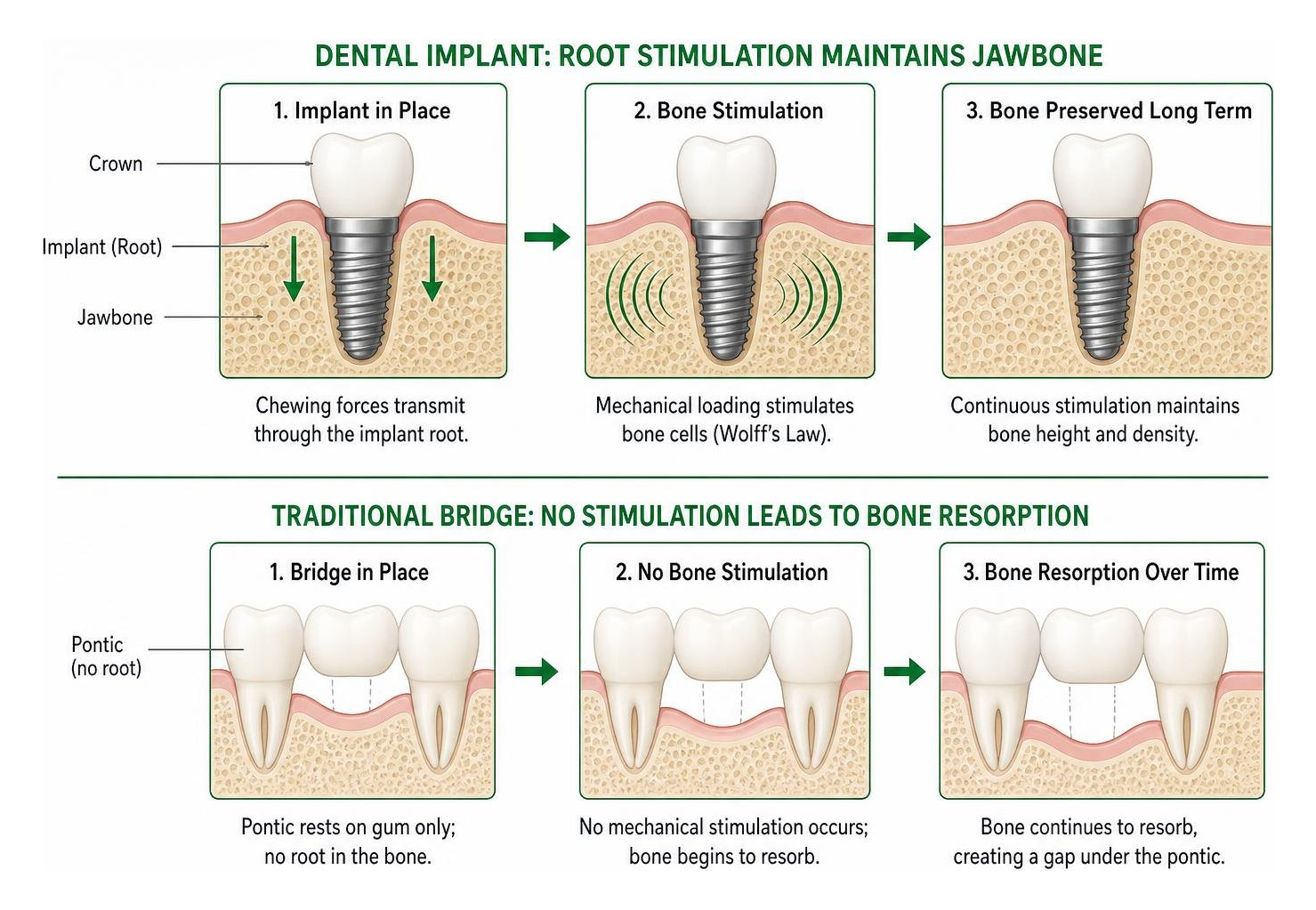
When a tooth is lost, that mechanical stimulation vanishes. Within the first year following tooth loss, the alveolar ridge can lose up to 50% of its structural width. Because a traditional bridge pontic simply rests on top of the gumline, it provides zero stimulation to the underlying bone. Over a decade or two, the bone beneath the pontic gradually recedes, leaving a visible gap beneath the false tooth where food particles collect.
Furthermore, placing a traditional bridge requires altering the teeth on either side of the gap. Even if those neighboring teeth are completely healthy and free of fillings, significant enamel and dentin must be permanently shaved down to accommodate the retaining crowns. This irreversible prep work increases the risk of tooth sensitivity, eventual root canal therapy, and secondary cavities beneath the crown margins. Exploring restorative dental bridge options is helpful when adjacent teeth already have large restorations or structural damage, but sacrificing virgin enamel is a major trade-off.
20-Year Financial and Cost-Effectiveness Analysis
When looking at treatment estimates, upfront price tags can be misleading. Patients often see that a bridge costs less out-of-pocket initially and assume it is the more affordable path. However, a 20-year financial analysis paints a very different picture.
Upfront Treatment Investment vs. Lifetime Replacement Expenses
In the current 2026 dental landscape, single dental implant procedures generally range from $3,500 to $6,500, including the surgical post, custom abutment, and final restoration. A 3-unit fixed bridge typically averages between $2,000 and $5,000 upfront. While dental insurance plans frequently provide immediate partial coverage for bridge fabrication, they may cover only portions of an implant, leading some to hesitate at the initial expense.
However, consider the timeline over two to three decades:
- Year 0: You invest in a 3-unit bridge.
- Year 10–12: Cement washouts or micro-leakage cause decay along the abutment margin. The bridge must be replaced, requiring new impressions, potential root canal therapy on a compromised abutment, and a brand-new 3-unit prosthesis.
- Year 20–24: The replacement bridge reaches the end of its functional life, requiring yet another full replacement or extraction of an overloaded abutment tooth.
By the second replacement cycle, the cumulative financial investment of maintaining, repairing, and remaking a bridge often surpasses the one-time surgical cost of a dental implant. Implants offer superior long-term cost stability because the primary structural post rarely requires re-intervention. You can review detailed local budgeting figures in our dental implants cost guide for 2026.
Value Comparison for Multiple Missing Teeth
When a patient is missing two, three, or four adjacent teeth, using natural teeth to support an extra-long bridge span introduces severe biomechanical leverage. Long-span bridges place excessive bite pressure onto the remaining natural roots, accelerating the risk of root fractures and premature tooth loss.
In these clinical scenarios, placing two independent dental implants to support an extended porcelain span—known as an implant-supported bridge—delivers unmatched structural stability. It distributes bite forces directly into the jawbone rather than straining natural teeth. For patients facing broader restorative needs, our team provides comprehensive implant-supported bridges and full restorations designed to preserve structural facial contours and deliver lifetime chewing efficiency.
Maintenance, Complications, and Transitioning Between Restorations
Daily home care is the deciding factor in how long any dental restoration survives. However, the cleaning mechanics for implants versus bridges are fundamentally different.
A single dental implant functions just like a natural tooth. You brush it normally with a soft-bristled brush and clean between the contacts with regular dental floss. To keep your gums firm and free of plaque around restorations, we also recommend using professional-grade oral care tools, such as the specialized cleaning aids available through our Casey Dental patient store.
Fixed bridges, on the other hand, cannot be flossed normally because the false tooth (pontic) is physically fused to the side crowns. Patients must master using floss threaders, flexible interdental brushes, or high-pressure water flossers daily to sweep out food debris trapped underneath the pontic. If this hygiene regimen lapses, bacteria quickly colonize the exposed margins of the supporting teeth.
Common Long-Term Complications and Failure Modes
Every dental restoration faces specific biological and mechanical risks over time:
Traditional Bridge Failure Modes:
- Recurrent Caries: The number-one cause of bridge failure is secondary bacterial decay sneaking under the crown margins of the natural support teeth.
- Structural Abutment Fracture: Uneven chewing stress or clenching can crack a weakened natural tooth beneath the crown.
- Cement Washout: Dental cement can slowly dissolve over years, allowing microscopic fluid and bacteria to sit undetected against bare dentin.
- Endodontic Complications: The initial tooth preparation process can occasionally traumatize the underlying dental pulp, requiring root canals years down the road.
Dental Implant Complications:
- Peri-Implant Mucositis and Peri-Implantitis: While titanium cannot get a cavity, the surrounding soft tissue and bone can become inflamed if plaque builds up along the gumline. If left untreated, peri-implantitis causes bone loss around the fixture.
- Prosthetic Screw Loosening or Wear: Chewing forces can eventually loosen the internal retaining screw or chip the outer porcelain, which is routinely corrected without touching the underlying bone post.
Maintaining clear communication with your clinician and following an evidence-based maintenance schedule is vital. For an in-depth breakdown of surgical timelines and hygiene steps, review this clinical guide to navigating dental implants.
Replacing a Failed Dental Bridge with an Implant
What happens when an older bridge eventually gives out? When an existing bridge fails due to decay or structural breakage of an abutment tooth, transitioning to a dental implant is often the most predictable way to stop the cycle of tooth loss.
However, replacing an old bridge with an implant involves extra planning. Because the bone beneath the missing tooth has likely experienced years of disuse atrophy, bone volume may be depleted. At Casey Dental, we use high-resolution Cone Beam Computed Tomography (CBCT) 3D imaging to evaluate your exact bone width and height. If the bone has receded, we can perform targeted bone grafting or a sinus lift to rebuild a rock-solid foundation prior to placing the implant. Learn more about your options for restoring failed dental work in our guide to missing teeth solutions.
Frequently Asked Questions About Implant and Bridge Durability
How long do dental implants last compared to fixed bridges?
Dental implants are designed as a permanent tooth replacement, with titanium fixtures regularly lasting 25 to 30 years or a lifetime with proper oral hygiene and regular exams. Over 10 years, implants maintain a 94% to 98% survival rate. Traditional fixed bridges have an average functional lifespan of 10 to 15 years before replacement is needed due to secondary decay, cement deterioration, or support tooth failure.
What happens to the jawbone under a dental bridge over time?
Because a dental bridge pontic sits above the gumline and does not connect to the jawbone, it provides no functional stimulation to the underlying bone tissue. Over time, the alveolar ridge slowly resorbs and recedes. This bone loss can create an aesthetic gap beneath the bridge, alter facial support, and make future implant placement more complex without bone grafting.
Is an implant more cost-effective than a bridge over 20 years?
Yes. Although a fixed bridge usually has a lower upfront cost, it typically requires complete replacement every 10 to 15 years and carries a risk of costly root canal treatments or extractions on the support teeth. A dental implant post rarely requires replacement, making its total cost of ownership significantly lower over a 20- to 30-year timeframe.
Conclusion: Choosing the Right Long-Term Solution for Your Smile
Choosing between a dental implant and a fixed dental bridge is one of the most important decisions you will make for your ongoing oral health. While bridges offer a quick, non-surgical fix that makes sense when neighboring teeth already need crowns, dental implants remain the gold standard for preserving jawbone volume, protecting natural tooth structure, and delivering decades of dependable chewing strength.
At Casey Dental in Pittston, PA, we combine advanced digital diagnostics, guided surgical technology, and compassionate care to tailor restorations to your unique anatomy, health profile, and budget. Whether you are replacing a recently extracted tooth, dealing with a broken bridge, or facing an urgent dental emergency that needs immediate attention, our experienced team is here to help you smile with confidence. Contact Casey Dental today to schedule your comprehensive restorative consultation and discover the best long-term path for your smile.