What Every Patient Should Know: A Complete Braces Guide
This braces guide covers everything you need to make a confident decision about orthodontic treatment — from types and costs to care and what to expect.
Quick overview:
| Topic | Key Takeaway |
|---|---|
| How braces work | Gentle, constant pressure gradually shifts teeth and reshapes bone |
| Types available | Metal, ceramic, lingual, self-ligating, and clear aligners |
| Best age to start | Evaluation at age 7 is ideal; treatment often begins ages 10–14 |
| Treatment length | Typically 12–24 months, up to 36 for complex cases |
| Average cost | Roughly $3,000–$8,000 depending on type and complexity |
| After braces | A retainer is required to keep teeth in their new position |
Getting braces is one of the most common dental decisions families make — yet most people still have a lot of questions before they start. Crooked teeth, crowding, and bite problems don’t fix themselves, and the longer they go untreated, the harder they can be to correct. Beyond the obvious cosmetic benefits, properly aligned teeth are also easier to clean and less prone to decay and gum disease.
Whether you’re a parent researching options for your child or an adult considering treatment for yourself, you’re not alone. According to the American Association of Orthodontists, adult patients now make up a significant portion of people seeking orthodontic care — roughly 20% of all orthodontic patients in the U.S. are over 18.
I’m Dr. Shawn Casey, DMD, founder of Casey Dental in Pittston, PA, with over 30 years of experience in general dentistry and orthodontic care — including Invisalign — making me well-equipped to walk you through this braces guide from start to finish. Let’s break down everything you need to know so you can move forward with confidence.
How Braces Work: The Science of Straightening
To understand how braces work, you have to look beneath the surface of the gums. While it might look like we are just pulling teeth into a straight line, the process is actually a sophisticated biological feat involving bone remodeling.
When we apply dental braces, we are using a system of brackets and wires to exert a mild, constant pressure on your teeth. This pressure is transferred to the periodontal ligament—the connective tissue that attaches the tooth to the surrounding jawbone.
As the pressure is applied:
- Bone Resorption: On the side where the tooth is moving toward, specialized cells called osteoclasts break down the bone.
- Bone Deposition: On the side the tooth is moving away from, cells called osteoblasts build new bone to fill the gap.
This constant “break down and build up” cycle allows the teeth to migrate through the jaw. It isn’t just about aesthetics; braces are designed to correct malocclusion, which refers to a “bad bite.” Whether you have an overbite, underbite, or crossbite, the goal of this braces guide is to explain how we achieve proper jaw alignment, ensuring your upper and lower teeth meet correctly when you chew or speak.
Choosing Your Path: A Comprehensive Braces Guide to Types
In May 2026, patients have more choices than ever before. Gone are the days when “train tracks” were the only option. Depending on your lifestyle, budget, and the complexity of your case, we can choose from several different technologies.
| Feature | Traditional Metal | Ceramic Braces | Lingual Braces | Clear Aligners |
|---|---|---|---|---|
| Material | High-grade Stainless Steel | Tooth-colored Ceramic | Metal (placed behind teeth) | Clear Plastic Trays |
| Visibility | High | Low | Invisible (from front) | Very Low |
| Durability | Very High | Moderate (can chip) | High | High (but can be lost) |
| Treatment Speed | Fast/Standard | Standard | Standard to Slow | Fast for mild/moderate |
Traditional Metal Braces
These remain the “gold standard” for a reason. Modern metal brackets are smaller and more comfortable than they were a decade ago. They are incredibly effective at treating complex overcrowding and severe bite issues. For teens, the ability to choose different colored elastics (the rubber bands) makes the process a bit more fun.
Ceramic Brackets
If you want the power of traditional braces but want them to be less noticeable, ceramic is an excellent choice. These brackets blend with your natural teeth because they are clear or tooth-colored. They are popular among adult professionals who want a discreet look.
Lingual Braces
Lingual braces are custom-made to fit on the inside (tongue-side) of your teeth. This makes them completely invisible when you smile. However, they can be more challenging to clean and may temporarily affect your speech more than other types.
Self-Ligating Braces
These use a specialized clip instead of elastics to hold the archwire in place. This creates less friction and can sometimes lead to fewer adjustment appointments, as the wire can slide more freely as teeth move.
Clear Aligners (Invisalign)
While not technically “braces” in the traditional sense, systems like Invisalign use a series of clear, removable trays. When considering Invisalign vs braces, the biggest factors are visibility and removability. You can take them out to eat and brush, but you must be disciplined enough to wear them for at least 22 hours a day.
Signs You Need a Braces Guide Evaluation
How do you know if it’s time to book a consultation? While some issues are obvious, others are hidden. Common signs include:
- Crowding: Teeth that overlap or are “bunched up.”
- Gaps: Noticeable spaces between teeth.
- Bite Issues: Your upper teeth significantly overlap the lower (overbite) or the lower teeth sit in front of the upper (underbite).
- Jaw Discomfort: Frequent jaw pain or clicking can indicate that your teeth aren’t aligned, putting stress on the TMJ.
- Difficulty Flossing: If you can’t get floss between certain teeth, they are likely too crowded, increasing your risk for cavities.
- Speech Impediments: Lisping or whistling sounds can sometimes be corrected by seeing an orthodontist.
Dietary Rules in Your Braces Guide
One of the biggest adjustments in this braces guide is the “No-No List.” To prevent broken brackets or bent wires, you’ll need to avoid:
- Sticky Foods: Gummy bears, taffy, and caramel can pull brackets off the teeth.
- Hard Foods: Hard pretzels, nuts, and ice can snap wires.
- Corn on the Cob: The action of biting into the cob is a recipe for a broken appliance; always cut the corn off the cob.
- Whole Apples: Like corn, you should slice apples into small, bite-sized pieces.
Instead, focus on a soft food diet during the first week and after adjustments. Think mashed potatoes, yogurt, smoothies, scrambled eggs, and pasta.
The Treatment Journey: What to Expect
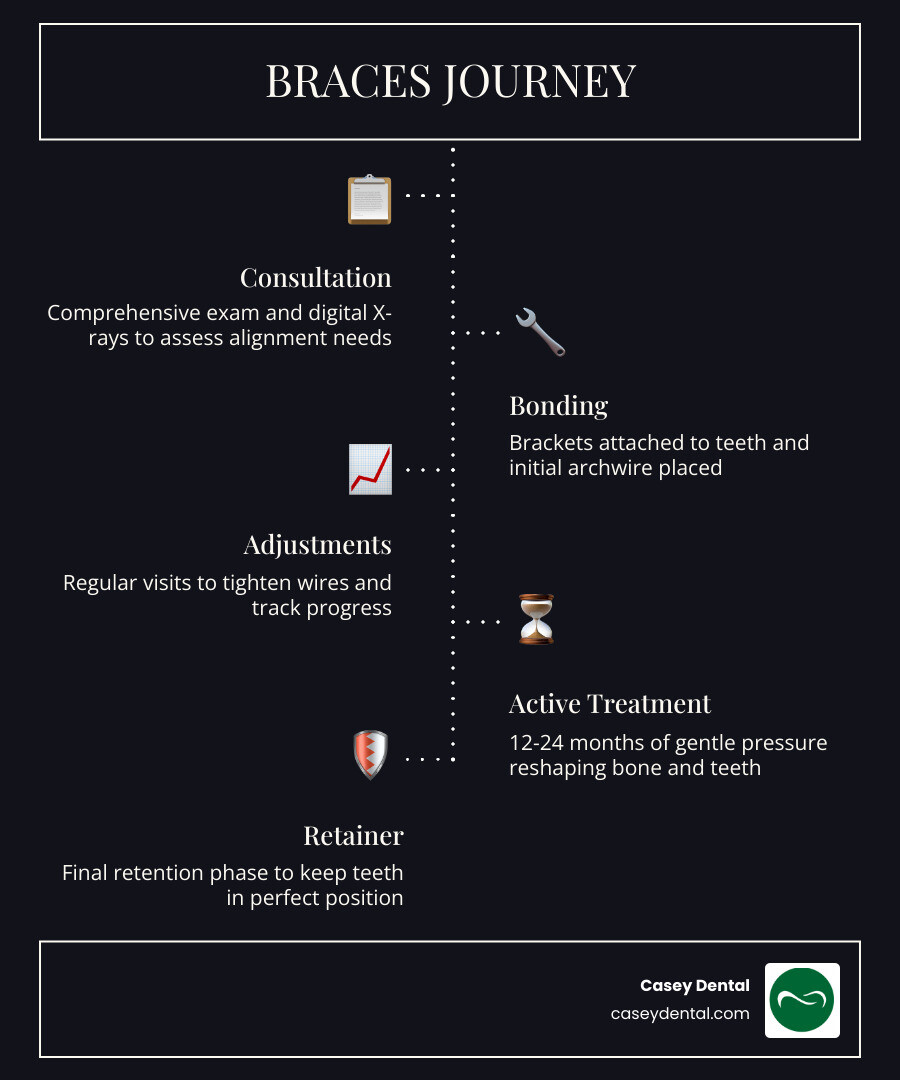
The process of getting a straighter smile is a marathon, not a sprint. Here is a realistic timeline of the journey to perfect teeth alignment:
- The Consultation: We’ll perform a thorough exam, take digital X-rays, and often use a 3D scanner to create a digital model of your mouth. This allows us to map out the exact movement of every tooth.
- Bonding Day: This is the day the braces actually go on. We clean and prime your teeth, apply a special adhesive, and bond the brackets. Then, we thread the archwire through. This appointment usually takes 1–2 hours.
- Adjustment Appointments: Every 4–10 weeks, you’ll visit us for a “tightening.” We’ll check your progress and swap out wires or elastics. This is where the real straight talk about fixing crooked teeth happens, as we fine-tune the pressure.
- Debonding: The best day of all! We carefully remove the brackets, polish the adhesive off your enamel, and reveal your new smile.
Most patients spend between 12 and 24 months in treatment, though complex cases can take up to three years.

Life with Braces: Care and Maintenance
Maintaining excellent oral hygiene is harder with braces, but it is more important than ever. Brackets and wires create “nooks and crannies” where plaque and food particles love to hide. If you don’t clean them, you risk developing white spot lesions (permanent stains) or cavities.
- Brushing: Use a soft-bristled brush or an electric toothbrush. Tilt the brush at a 45-degree angle to clean above and below the wire.
- Flossing: This is the tricky part. Use a floss threader or specialized orthodontic floss to get under the wire. Many of our patients find that a water flosser is a lifesaver for flushing out debris.
- Interproximal Brushes: These tiny “Christmas tree” brushes are perfect for cleaning between the brackets.
- Orthodontic Wax: If a bracket or wire is poking your cheek, a small pea-sized amount of wax can provide an instant barrier and relief.
Investment and Aftercare: Costs and Retainers
We understand that the cost of braces is a significant investment for any family. On average, you can expect to pay anywhere from $3,000 to $8,000.
Several factors influence the price:
- Case Complexity: How much movement is required?
- Type of Braces: Metal is generally the most affordable, while lingual or custom 3D-printed systems are the most expensive.
- Duration: Longer treatment times often mean more appointments and higher costs.
Many patients ask, “Does dental insurance cover braces?” The answer varies. Some plans cover a percentage (often 25–50%) for children under 18, while adult coverage is less common but increasing. We offer flexible payment plans to help make this life-changing treatment accessible.
The Retention Phase
Your journey doesn’t end when the braces come off. Teeth have a “memory” and will naturally want to shift back to their old positions. This is why retainers are mandatory. You might receive a Hawley retainer (metal and acrylic), an Essix retainer (clear plastic), or a permanent lingual wire bonded to the back of your teeth. Usually, you’ll wear them full-time for a few months, then every night indefinitely.
Frequently Asked Questions about Braces
How long does orthodontic treatment typically take?
On average, treatment lasts 18 to 24 months. However, simple alignment issues might be resolved in under a year, while complex bite corrections can take longer. Your compliance—wearing your rubber bands and avoiding broken brackets—is the biggest factor in staying on schedule. Even Invisalign timelines depend heavily on how many hours a day you wear the trays.
Do braces hurt?
The placement itself isn’t painful, but you will feel initial soreness and pressure for 3–5 days after getting them on and after each adjustment. This is normal! Over-the-counter pain relievers like acetaminophen and warm saltwater rinses can help soothe the mouth.
What is the best age for braces?
The American Dental Association recommends an orthodontic evaluation by age 7. At this age, we can spot issues with jaw growth and emerging permanent teeth. Most kids start full treatment between ages 10 and 14, but remember: you are never too old for a healthy smile!
Conclusion
Whether you are looking to correct a complex bite issue or simply want to enhance your smile’s aesthetics, the team at Casey Dental in Pittston, PA, is here to guide you through every step of your orthodontic journey. We provide expert care for patients of all ages, ensuring a comfortable experience and lasting results. For those currently in treatment, you can find essential hygiene products in our patient store to keep your smile healthy. Ready to transform your smile? Contact us today at Casey Dental to schedule your consultation and take the first step toward a healthier, straighter smile.