How Long Does Invisalign Take, and Why Might It Take Longer?
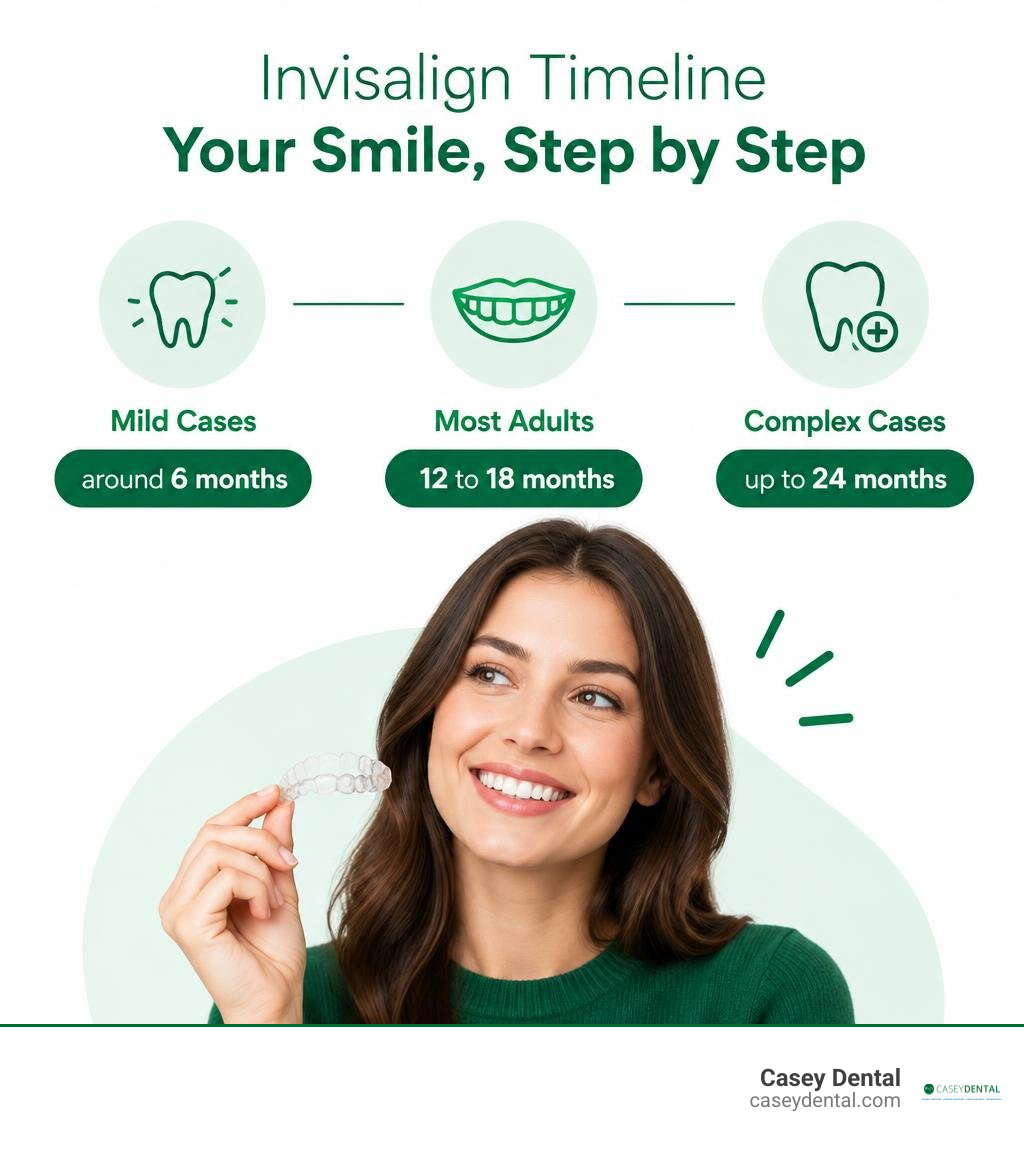
The question how long does invisalign take? has a short answer: most adults can expect about 12 to 18 months. Mild cases may finish in around 6 months, while complex tooth or bite changes can take up to 24 months. Wearing aligners less than the recommended 20 to 22 hours a day, or needing extra refinement trays, can extend the timeline.
I’m Dr. Shawn Casey, founder of Casey Dental in Pittston and a dentist since 1994. When I answer how long does invisalign take? for a patient, I start with their teeth, bite, and treatment plan.
Easy how long does invisalign take glossary:
How Long Does Invisalign Take on Average?
When patients visit our office asking about their overall treatment roadmap, we look at national clinical averages alongside their personalized oral architecture. Across general adult populations, the median finishing time lands right around 14 months. Specifically, the fastest 25th percentile of cases wraps up in roughly 10 months, while the 75th percentile extends out to 18 months.
Modern Invisalign clear aligner therapy relies on advanced ClinCheck 3D digital planning software to map out microscopic movements before you even snap in your first tray. Each aligner is engineered to apply gentle, continuous pressure to guide teeth into place incrementally.
| Invisalign Tier | Typical Tray Count | Severity Level | Estimated Total Duration |
|---|---|---|---|
| Invisalign Express | Up to 7 trays | Very minor spacing or relapse | 3 to 6 months |
| Invisalign Lite | Up to 14 trays | Mild crowding or gap closure | 4 to 9 months |
| Invisalign Moderate | 15 to 20 trays | Moderate rotation & alignment | 9 to 14 months |
| Invisalign Comprehensive | Unlimited trays | Complex bite issues & crowding | 12 to 24+ months |
How Long Does Invisalign Take for Mild vs. Complex Cases?
The structural severity of your smile is the primary blueprint for your timeline. Mild aesthetic cases—such as minor front-tooth overlapping or small gaps—generally finish in 6 to 9 months. In these scenarios, the roots of your teeth move minimal distances, and the jawbone remodels quickly around the new tooth positions.
In contrast, moderate cases typically require 9 to 15 months, while complex cases involving severe malocclusion, deep overbites, underbites, crossbites, or significant rotational difficulty routinely require 15 to 24 months. Moving roots across dense bone structures and correcting the functional way your upper and lower arches fit together takes biological time that cannot be rushed.
Invisalign Tiers Explained: Express, Lite, Moderate, and Comprehensive
Align Technology organizes clear aligner therapy into distinct tiers based on the number of trays needed to achieve your clinical goals. Understanding these tiers helps demystify your projected calendar:
- Invisalign Express: Designed for minor orthodontic relapse (such as forgetting your retainers years after childhood braces), this tier utilizes up to 7 trays and completes in 3 to 6 months.
- Invisalign Lite: Geared toward straightforward cosmetic adjustments, Lite uses up to 14 trays and runs between 4 and 9 months.
- Invisalign Moderate: Ideal for moderate spacing or crowding that requires deeper arch development, utilizing 15 to 20 trays over 9 to 14 months.
- Invisalign Comprehensive: Formerly known as Invisalign Full, this package provides unlimited trays and refinements for multi-directional shifts and functional bite corrections over 12 to 24 months.
Properly evaluating clear aligner candidacy ensures you are matched with the right tier so expectations stay completely aligned with reality from day one.
Month-by-Month Invisalign Timeline: What to Expect
Understanding the month-by-month flow of treatment helps you stay motivated and track your smile’s transformation.
- Month 0 (Consultation & Digital Scanning): We capture high-resolution 3D digital impressions using intraoral scanners. We review your ClinCheck simulation, showing you a virtual model of how your teeth will shift stage by stage.
- Month 1 (Getting Started & Attachment Bonding): You receive your initial sets of aligners. During this visit, we place small, tooth-colored composite buttons (attachments) on specific teeth. These act as grip handles for the plastic trays to deliver targeted rotational forces. You might feel mild tightness for 24 to 48 hours as your periodontal ligaments adapt.
- Months 2 to 3 (Early Shifts & Visible Movement): Teeth begin shifting on a microscopic level within the first few weeks, but by the two-to-three-month mark, you will likely notice visible changes in your smile line and flossing contact points.
- Months 4 to 6 (Mid-Treatment Tracking & Major Milestones): Front teeth alignment continues smoothing out, and you will visit us for progress check-ins. Maintaining excellent oral health is critical during this phase; you can pick up specialized patient oral hygiene supplies to keep your enamel sparkling and trays free from plaque buildup.
- Months 7 to 12 (Deep Alignment & Arch Expansion): For moderate to comprehensive cases, these months focus on premolar and molar movement, resolving deeper crowding, and aligning arch widths.
- Months 12 to 18 (Bite Detailing, Refinement & Retention): Final rotational tweaks occur, bite balancing is finalized, and you transition into custom post-treatment retainers to lock your results in place.
Why Your Invisalign Treatment Might Take Longer Than Expected

Even the most meticulously designed digital treatment plan can encounter real-world detours. If your expected completion date is drifting further into the future, several common variables could be slowing down your tooth movement.
Inconsistent Daily Wear and Tracking Delays
The single most influential factor in your treatment speed is daily wear-time compliance. Clear aligners are engineered around a strict rule: 20 to 22 hours per day. Trays should only come out when you are eating, drinking anything other than plain cool water, or brushing your teeth.
When aligners remain out of the mouth for extended periods—dropping to 16 to 18 hours daily—the biological forces driving bone remodeling stall. Teeth will stop “tracking,” meaning they fail to match the internal geometry of the plastic tray. When a tracking gap forms, the next tray in your series will not seat fully, forcing your dentist to pause progression, back up several trays, or order new impressions. Inconsistent daily wear can easily add 3 to 12 months to what should have been a straightforward case. Using silicone aligner chewies daily helps seat your trays firmly over attachments to prevent tracking lag.
Refinement Rounds and Mid-Course Corrections
Many patients believe that receiving an initial box of 25 trays guarantees their journey ends on tray 25. However, between 60% and 70% of all Invisalign cases require at least one round of refinement trays.
A refinement round is not a failure; it is a routine detailing phase. Some teeth—particularly rounded lower premolars or upper lateral incisors—can be biologically stubborn when attempting complex rotations. Once your primary series concludes, we take a new 3D scan to design a short series of refinement aligners. A typical refinement round adds 3 to 6 months to your total calendar, ensuring your final occlusion and aesthetic symmetry are flawless.
Biological Factors, Age, and Dental History
Orthodontic movement depends on cellular turnover within the alveolar bone. Osteoclasts must break down bone tissue in the path of the moving tooth, while osteoblasts rebuild bone behind it. While adult clear aligner treatment is highly effective at any age, mature adult bone is denser and remodels at a slightly more deliberate pace than the malleable jawbones of adolescents.
Additionally, individual dental history plays a key role. Teeth that have undergone past trauma, severe root canal therapy, or previous periodontal bone loss move differently. In rare cases, a tooth may be partially fused to the surrounding bone (ankylosis), preventing standard movement and requiring manual adjustments to your overall plan.
Clear Aligners vs. Traditional Orthodontics: Speed Comparison
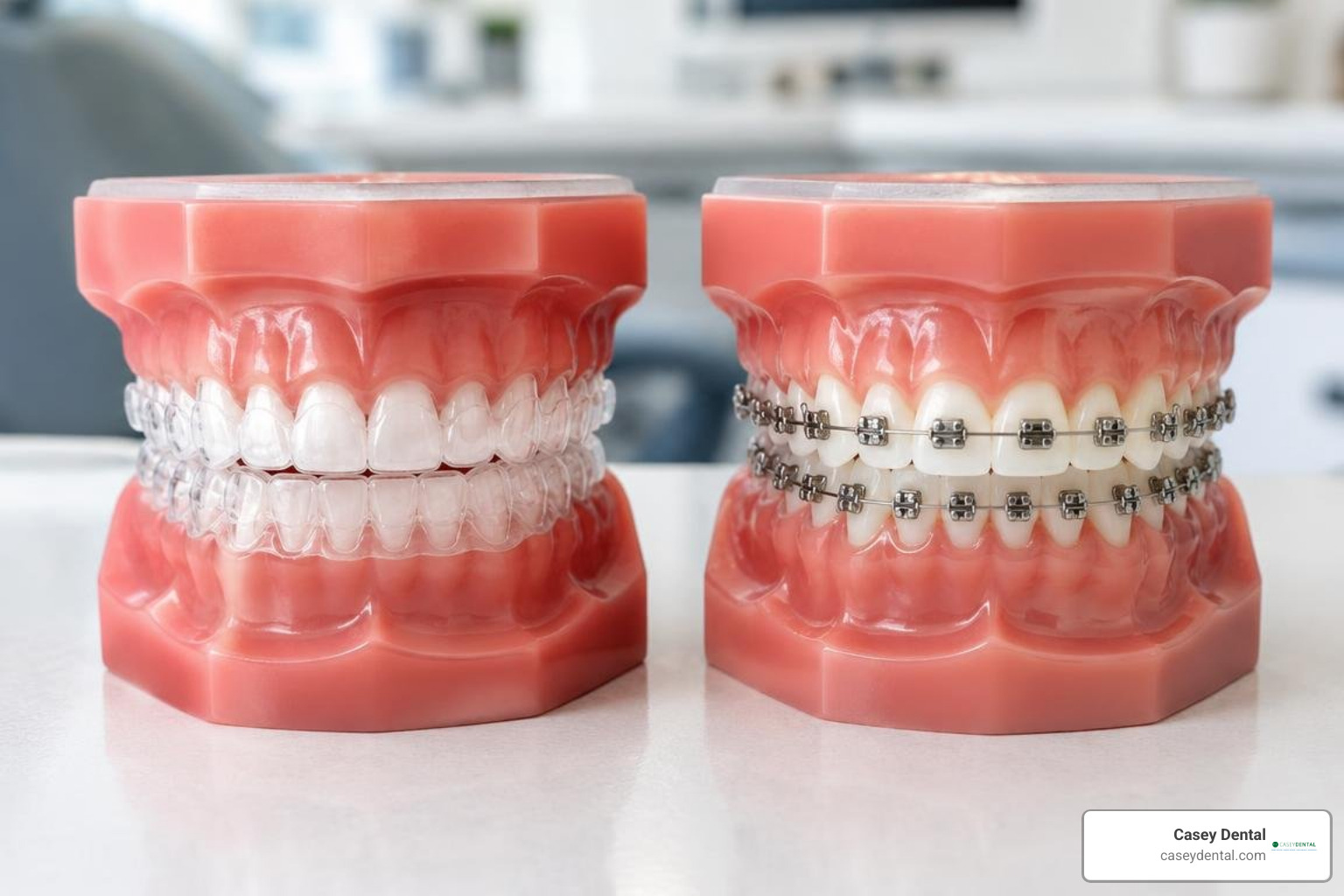
Patients frequently weigh comparing braces vs aligners to see which method delivers a straighter smile in less time. The truth is that both systems have specific mechanical strengths depending on what your teeth need to accomplish.
How Long Does Invisalign Take Compared to Traditional Braces?
For mild to moderate alignment corrections, Invisalign is often faster than traditional wire-and-bracket systems. Clear aligners deliver pre-programmed, direct surface contact across the entire crown of each tooth, and patients avoid common braces emergencies like broken brackets, bent archwires, or missed manual adjustment appointments.
However, for severe rotational corrections, large vertical tooth extrusions, or severe skeletal jaw discrepancies, traditional fixed braces can sometimes work 3 to 9 months faster because brackets exert continuous, unyielding tensile force 24 hours a day without relying on patient compliance. When choosing between braces and aligners, your case complexity and daily dedication determine which system is truly the fastest path forward.
Retention: Protecting Your Results After Treatment Ends
Crossing the finish line of your aligner series is an exciting milestone, but the active movement phase is only step one. Once your teeth arrive at their ideal positions, the surrounding bone and periodontal fibers need time to solidify and mature around the new root placements. Without dedicated retention, natural elastic memory can cause orthodontic relapse, undoing months of hard work.
During the initial retention phase (typically the first 3 to 6 months), you will wear custom Vivera or clear retainers full-time, just like your aligners. Afterward, you will transition to wearing your retainers strictly at night. Lifelong nighttime wear is the golden rule of orthodontic stability, ensuring your straight, healthy smile remains permanent for decades to come.
Frequently Asked Questions About Invisalign Timelines
How quickly will I see visible results with Invisalign?
Most patients begin seeing noticeable visual shifts in their front teeth within 2 to 3 months of consistent, 22-hour daily wear. Microscopic movements start within the very first week, but space closures and initial uncrowding usually become obvious to friends and family around tray 8 to 12.
Do refinement trays mean my Invisalign treatment failed?
Not at all. Refinements are a planned, standard part of the clear aligner protocol for 60% to 70% of patients. Because human biology does not always follow computer simulations with 100% precision, refinement trays simply provide the micro-adjustments needed to achieve total clinical perfection.
Can I speed up my Invisalign treatment safely?
The safest and most reliable way to keep your treatment moving fast is strict compliance. Wear your trays 22 hours per day, use aligner chewies for 5 to 10 minutes daily to eliminate air gaps, change your trays on the exact day scheduled by your dentist, and maintain meticulous oral hygiene so gum inflammation never delays your progress.
Conclusion
Every smile is distinct, and having a clear understanding of your personal timeline turns orthodontic care into a predictable, rewarding journey. While the typical adult experience lasts between 12 and 18 months, maintaining disciplined daily wear and attending all planned progress evaluations ensures you reach your goals without unnecessary delays.
At Casey Dental in Pittston, PA, our experienced team utilizes state-of-the-art 3D imaging to build personalized clear aligner roadmaps tailored to your lifestyle and comfort. Whether you are seeking a complete smile transformation, routine family dentistry, or immediate assistance for a sudden dental emergency, we provide comprehensive, one-stop oral health care for patients of all ages. If you are ready to discover exactly how long your new smile will take, schedule a consultation with Casey Dental today and let our family care for yours!