When Does a Dental Problem Actually Need Same-Day Care?
Understanding dental emergencies that can wait vs. can’t wait could mean the difference between saving a tooth and losing it — or between a quick dental visit and an expensive ER trip.
Here’s a fast reference to help you decide right now:
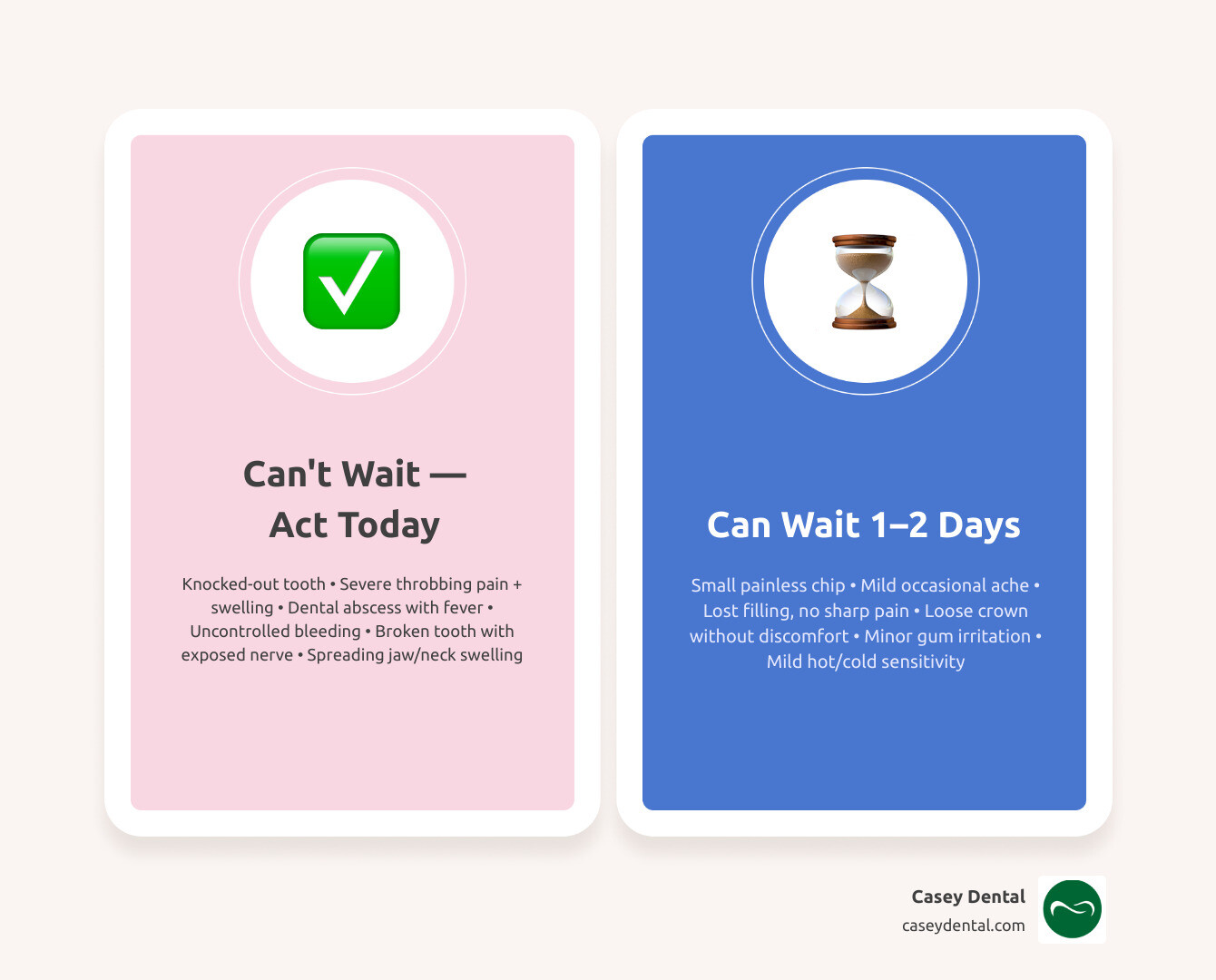
| Can’t Wait — Act Today | Can Wait 1–2 Days |
|---|---|
| Knocked-out permanent tooth | Small chip with no pain |
| Severe, throbbing pain with swelling | Mild, occasional toothache |
| Dental abscess (pus, fever, bad taste) | Lost filling with no sharp pain |
| Uncontrolled bleeding (10+ min) | Loose crown, no pain |
| Broken tooth with exposed nerve | Minor gum irritation or bleeding |
| Spreading swelling to jaw or neck | Mild hot/cold sensitivity |
| Loose permanent tooth after trauma | Broken brace wire |
The fastest rule of thumb: If you have severe pain, swelling, uncontrolled bleeding, or a knocked-out tooth — don’t wait. If the discomfort is mild, stable, and manageable with over-the-counter pain relief, you can usually schedule a next-day or next-business-day appointment.
It’s a scenario many people know too well. A sharp pain hits on a Friday night, or you take a tumble during a weekend game and chip a tooth. Suddenly you’re stuck wondering: Is this a true emergency, or can it wait until Monday? Getting that call wrong in either direction has real consequences — waiting too long on a serious infection can put your health at risk, while rushing to an ER for a minor chip often means hours of waiting and a bill in the hundreds or thousands of dollars, only to be told to follow up with a dentist anyway.
I’m Dr. Shawn Casey, founder of Casey Dental in Pittston, PA, and with over 30 years of experience treating dental emergencies across northeast Pennsylvania, I’ve helped countless patients navigate exactly this question of dental emergencies that can wait vs. can’t wait. In the sections below, I’ll walk you through a clear, practical guide so you always know what to do — and where to go — when a dental problem catches you off guard.
Dental Emergencies That Can Wait vs Cant Wait: The Fastest Way to Tell
When you’re in pain, everything feels like an emergency. However, in clinical dentistry, we categorize issues based on the risk of permanent damage, the severity of infection, and the level of pain.
A “true” dental emergency is any situation that requires immediate treatment to stop persistent bleeding, alleviate excruciating pain, or save a tooth that has been knocked out or severely damaged. On the other hand, “urgent” but non-emergency problems are those that need attention within 24 to 48 hours but aren’t life-threatening or likely to cause permanent tooth loss if they wait for a regular business day.
What makes a true dental emergency?
If you are experiencing any of the following, you are dealing with a situation that cannot wait:
- A Knocked-Out Tooth: This is the “code red” of dentistry. You have a narrow window — ideally 30 to 60 minutes — to get to a dentist if you want to save the tooth.
- Severe, Unrelenting Pain: If the pain is a 7 or higher on a scale of 1-10, keeps you awake at night, and doesn’t respond to over-the-counter medication, it’s an emergency.
- Signs of an Abscess: This is a serious infection. Look for a “pimple” on the gums, facial swelling, a foul taste, or a fever. Infections cause the vast majority (85%) of dental-related hospital admissions, so we take these very seriously.
- Uncontrolled Bleeding: If you’ve had an injury or a recent extraction and the bleeding doesn’t stop after 10–15 minutes of firm pressure, you need professional help.
- Large Fractures or Exposed Nerves: If a tooth is broken in half or you can see pink or yellow tissue inside the tooth, the nerve is likely exposed, which is incredibly painful and prone to rapid infection.
What counts as urgent but can wait a day or two?
Many issues are annoying or uncomfortable but don’t technically require a midnight trip to the clinic. These include:
- Lost Fillings or Crowns: While it feels weird, as long as there isn’t severe pain, you can usually wait until the next morning.
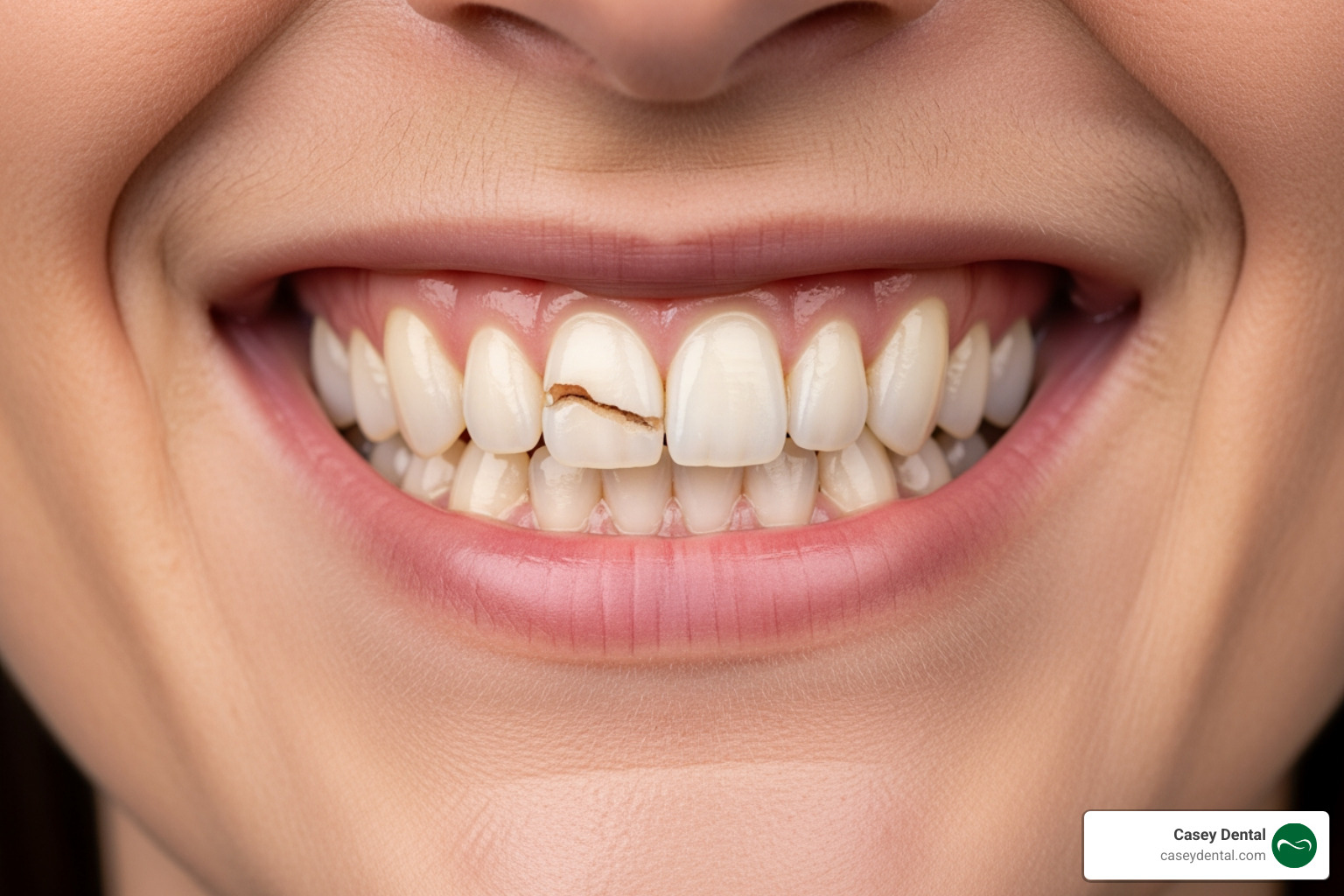
- Small Chips or Cracks: If there are no sharp edges cutting your tongue and no intense pain, this can wait for a scheduled appointment.
- Mild Toothaches: If the pain is dull, intermittent, and manageable with ibuprofen, it’s likely not an immediate emergency.
- Broken Braces or Wires: Unless a wire is poking into your cheek and causing bleeding that you can’t stop with dental wax, this is a routine repair.
The 3-question self-check for dental emergencies that can wait vs cant wait
If you’re still unsure, ask yourself these three questions:
- Is the pain severe and constant? (If yes, it can’t wait.)
- Is there significant swelling in the face, jaw, or gums? (If yes, it can’t wait.)
- Is there a risk of losing a tooth permanently due to trauma? (If yes, it can’t wait.)
If you answered “no” to all three, you are likely safe to wait for a regular appointment. When in doubt, it is always safer to call us at Casey Dental. We can triage your symptoms over the phone and tell you exactly how quickly you need to be seen.
Symptoms You Should Never Ignore

Some symptoms are “red flags” that indicate a problem is moving from your mouth into the rest of your body. Ignoring these can lead to systemic health crises.
Same-day or within-hours problems
Certain issues need to be addressed before the sun goes down. A dental abscess is a pocket of pus caused by a bacterial infection. It will not go away on its own. If you notice a throbbing pain that radiates to your jawbone, neck, or ear, combined with sensitivity to temperature and pressure, you need to see us immediately.
Another “must-act” symptom is a tooth that has been partially dislodged (extruded). If your tooth looks longer than the others or is extremely loose after a hit to the face, we may be able to save it if we splint it back into place quickly.
Red flags that mean go now, not later
There are rare occasions where a dental problem becomes a medical emergency. You should skip the dentist and head straight to the nearest Emergency Room if you experience:
- Difficulty breathing or swallowing (this suggests swelling is closing your airway).
- Swelling that is spreading toward your eye or down your neck.
- A suspected broken jaw or facial bones.
- High fever and chills accompanying a toothache.
- Severe head trauma (concussion symptoms) along with dental injuries.
Why waiting can make things worse
Delaying treatment for a true emergency isn’t just about enduring pain; it’s about the clinical consequences. For example, up to 65.5% of patients with cracked teeth are likely to develop irreversible pulpitis, an infection of the tooth pulp that typically requires root canal therapy.
What starts as a $200 filling can quickly escalate into a $1,500 root canal and crown if the bacteria reaches the nerve. Even worse, untreated infections can enter the bloodstream, leading to sepsis or hospitalizations that often result in significantly higher costs than a dental visit.
What Can Usually Wait for a Regular Appointment
Not every crack or twinge is a catastrophe. In fact, many “scary” looking dental issues are perfectly safe to monitor for 24 to 48 hours.
Mild pain, small chips, and sensitivity
If you have a dull ache that comes and goes, or your tooth “zings” when you drink cold water but stops immediately after, you likely have a cavity or thinning enamel. While you should schedule a regular appointment, you don’t need to cancel your weekend plans.
Small chips that only affect the enamel (the white outer layer) are generally cosmetic. As long as the tooth isn’t sharp enough to lacerate your cheek, we can smooth it out or bond it during normal business hours.
Lost fillings, crowns, and minor gum irritation
Losing a crown is a common “weekend” problem. If the crown is still intact, keep it clean and bring it with you. You can even use a tiny dab of toothpaste or over-the-counter dental cement to temporarily hold it in place. If you’ve lost a filling, you can use a piece of sugar-free gum to plug the hole and prevent food from getting stuck, which can cause sensitivity.
Minor gum irritation, such as a small amount of bleeding after flossing or a “sore spot” from a new denture, is usually not an emergency. Saltwater rinses are your best friend here until you can see us.
Emergency Dentist or ER? Where to Go and What to Do First
One of the biggest mistakes patients make is going to the ER for a toothache. While ER physicians are heroes, they are not dentists. They generally do not have high-speed drills, dental X-ray machines, or the materials needed for permanent repairs.
When to call an emergency dentist first
For 90% of dental issues, the dentist is the right choice. We can actually fix the problem — whether that means performing a root canal, extracting a tooth, or placing a permanent filling. At Casey Dental, we prioritize emergency dentistry because we know that every second counts for your smile.
If you call an emergency dentist, you are getting specialized care that addresses the root cause, not just a temporary bandage. You can learn more about what to expect in our guide on emergency dental care: what you need to know.
When to go to the ER instead of waiting for a dentist
As mentioned in the “Red Flags” section, the ER is for life-threatening issues. If you can’t breathe, can’t swallow, or have a suspected broken bone, the ER is the only place equipped to stabilize you. For more help deciding, check out this external guide on what counts as a dental emergency.
Why the ER is usually slower and more expensive for dental pain
Data shows that patients with dental pain frequently wait 4-8 hours or longer before being seen in emergency rooms. Furthermore, ER visits for dental problems often result in significantly higher costs than seeing a dentist. Between facility fees and physician charges, you could be looking at thousands of dollars for a prescription for antibiotics and a suggestion to “see your dentist on Monday.”
By coming to Casey Dental first, you avoid the “duplicate charge” of paying for an ER visit and then paying again for the actual dental repair.
Safe First Aid at Home While You Wait
If you’ve determined that your situation is one of the dental emergencies that can wait vs. can’t wait, or if you’re currently en route to our Pittston office, here is how to handle the situation safely.
What to do for a knocked-out, broken, or cracked tooth
- Find the tooth or fragments. Pick it up by the crown (the chewing surface), never the root.
- Rinse gently. If it’s dirty, use water. Do not scrub it or use soap.
- Try to reinsert. If it’s a permanent tooth, try to gently push it back into the socket and bite down on gauze.
- Store it properly. If it won’t go back in, place it in a small container of milk or a tooth-preservation solution. If those aren’t available, keep it in your cheek (if you won’t swallow it). The goal is to keep the root cells alive.
- Act fast. Remember the 30-60 minute window.
For more detailed steps, see our article on how to handle a broken tooth emergency or our guide on filling a broken tooth.
How to manage pain, swelling, and bleeding safely
- Pain Relief: Ibuprofen (Advil/Motrin) is usually more effective for dental pain than acetaminophen (Tylenol) because it reduces inflammation.
- Swelling: Apply a cold compress to the outside of your cheek for 20 minutes on, 20 minutes off.
- Bleeding: Bite down firmly on a piece of clean gauze or even a moistened tea bag (the tannic acid helps clots form).
- Elevation: Sleep with your head elevated on extra pillows to reduce the throbbing pressure in your jaw.
What not to do at home
- Do not put aspirin on your gums. It won’t help the tooth, and the acid will cause a chemical burn on your soft tissue.
- Do not try to pop an abscess. This can push the infection deeper into your tissues.
- Do not use super glue. This may seem obvious, but we’ve seen it! Super glue is toxic and makes it much harder for us to repair the tooth properly.
- Do not take “leftover” antibiotics. Only a dentist can determine the right type and dosage for a dental infection.
How to Prevent Future Dental Emergencies
While we are always here for you in an emergency, we’d much rather see you for a routine cleaning! Most dental emergencies are preventable.
Habits that lower your risk year-round
- Wear a Mouthguard: Falls are responsible for about 65% of all dental injuries. If you play sports, a custom-fitted mouthguard is the best insurance policy for your smile.
- Don’t Use Your Teeth as Tools: Your teeth are for chewing food, not for opening packages, cracking nuts, or biting your nails.
- Avoid Chewing Ice: This is a leading cause of micro-cracks that eventually turn into major fractures.
- Regular Checkups: We can spot a failing filling or a small cavity before it turns into a midnight toothache. If you’re currently in pain, don’t grin and bear it.
When a “small problem” deserves a sooner visit
If you’ve recently had an extraction and the pain is getting worse after three days, you might have a dry socket. This isn’t a life-threatening emergency, but it is incredibly painful and won’t heal on its own comfortably. Give us a call so we can dress the site and give you instant relief.
Frequently Asked Questions About Dental Emergencies That Can Wait vs Cant Wait
How long can I wait with a toothache before it becomes an emergency?
If the pain is mild and responds to ibuprofen, you can usually wait 24–48 hours for a regular appointment. However, if the pain is accompanied by fever, facial swelling, or a “pimple” on the gums, it has already become an emergency.
Can a lost filling or crown wait until Monday?
Yes, usually. If there is no intense pain or sharp edges, you can use temporary dental cement from a pharmacy to protect the tooth. Avoid chewing on that side and keep the area very clean until you can see us.
Is jaw swelling always a dental emergency?
Localized swelling around a tooth is an urgent dental matter. However, if the swelling is spreading to your neck or making it difficult to swallow or breathe, it is a medical emergency that requires an immediate ER visit.
Conclusion
At Casey Dental, we understand that dental pain doesn’t follow a 9-to-5 schedule. Whether you’re dealing with a situation that can’t wait — like a knocked-out tooth or a severe infection — or something that can wait a day or two, our team in Pittston, PA, is ready to provide the high-quality, compassionate care you deserve. We utilize cutting-edge technology to ensure your visit is as fast and comfortable as possible.
If you are currently experiencing a dental emergency, don’t wait for the problem to get worse. Contact Casey Dental today or learn more about our emergency dentist services. For your everyday dental needs, you can also browse our patient store for professional-grade oral care products to keep your smile healthy and emergency-free!