
Why a Retainer After Braces Protects Your New Smile
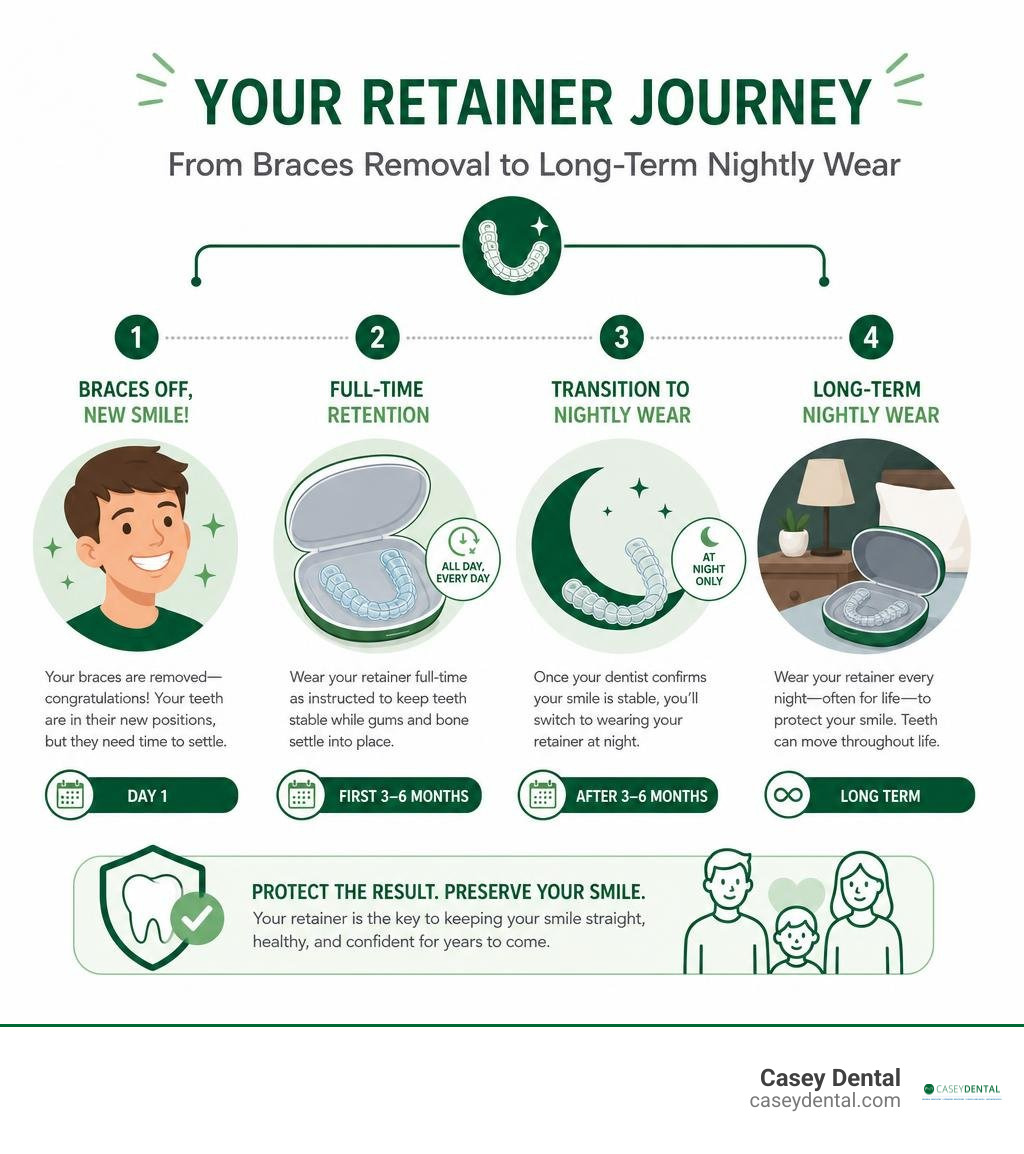
A retainer after braces keeps your teeth from shifting after treatment ends. Most people need to wear a removable retainer full-time at first, then at night long term – often for life – because teeth can move throughout adulthood.
Braces and Invisalign move teeth through bone and gum tissue. Once treatment ends, those tissues need time to settle. Without retention, teeth may gradually crowd, rotate, or develop gaps again, with the greatest risk of relapse during the first 12 to 18 months.
Your braces coming off is a milestone, not the end of protecting your smile.
I am Dr. Shawn Casey, founder of Casey Dental in Pittston and a dentist with more than three decades of experience in modern dental care, including orthodontics and Invisalign. I help patients understand that a retainer after braces is the simple long-term habit that helps preserve the result they worked hard to achieve.
Quick look at retainer after braces:
Why You Need a Retainer After Braces
Finishing orthodontic treatment is an exciting day. After months or years of wearing brackets, wires, or clear aligners, seeing your straight teeth in the mirror feels fantastic. However, teeth do not automatically stay in their new positions once active treatment concludes. Without custom appliances holding them stable, orthodontic relapse begins almost immediately.
Understanding The Ins and Outs of Braces helps explain why retention is essential. During active orthodontic movement, pressure creates microscopic changes in the surrounding soft tissue, jawbone, and connective fibers holding your teeth in place. Once active forces stop, those tissues try to return to their original configurations.
Clinical research highlights the critical necessity of retention. A landmark study on Post-treatment stability after 5 years of retention with vacuum-formed and bonded retainers—a randomized controlled trial showed that without active retention compliance, measurable dental shifting occurs rapidly across all patient groups. Protecting your straight teeth requires continuous support while your mouth stabilizes.
The Science of Bone Remodeling and Ligament Memory
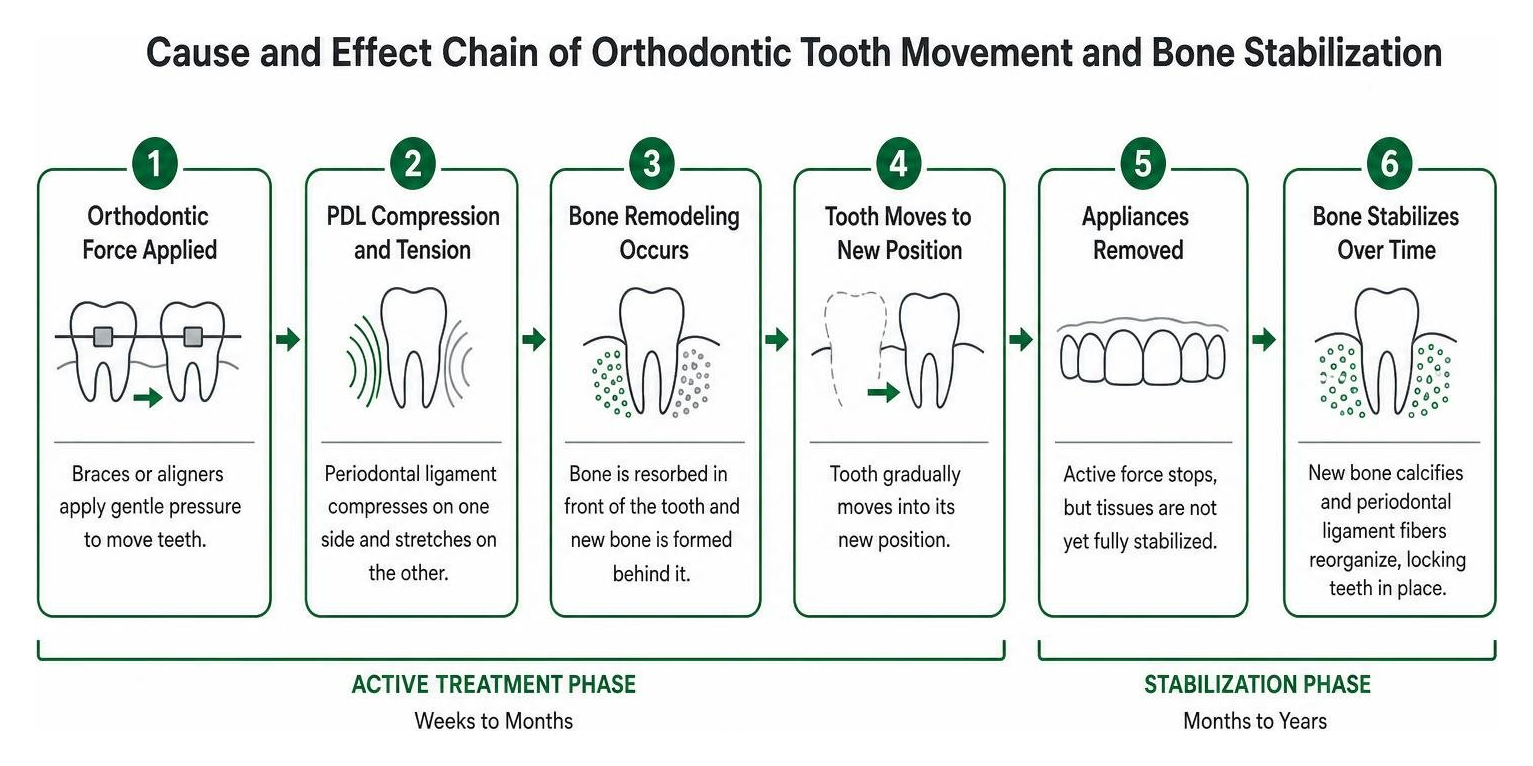
The underlying reason teeth move post-treatment involves biological mechanics. Teeth are held inside jawbone sockets by the periodontal ligament (PDL)—a network of elastic collagen fibers. When braces move teeth, the PDL stretches on one side and compresses on the other. This process triggers bone remodeling, where specialized cells breakdown bone in front of the moving tooth and build new bone tissue behind it.
When your orthodontic appliances are removed, the surrounding jawbone has not fully solidified around the newly placed teeth. It takes approximately 9 to 12 months for new bone tissue to fully calcify and consolidate around tooth roots.
Furthermore, periodontal ligaments possess “elastic memory.” Much like a stretched rubber band, these tiny collagen fibers pull against tooth roots for months, attempting to yank them back toward their original pre-treatment positions. On top of ligament memory, ongoing natural forces like bite pressure, swallowing habits, tongue resting positions, and late lower jaw growth into your mid-20s exert constant subtle forces on your alignment.
What Happens to Your Teeth Without a Retainer After Braces
If you stop wearing your retainer after braces, relapse happens in predictably structured stages:
- 1 to 2 Weeks: Teeth begin micro-shifting. When you try putting your appliance back in, it feels unusually tight or uncomfortable.
- 1 to 3 Months: Visible alignment loss occurs. Subtle rotations, minor gaps, or mild crowding become noticeable in mirror close-ups.
- 6 Months and Beyond: According to clinical summaries on How Long to Wear a Retainer After Braces: The Full Truth | Willow Family Dentistry, patients who abandon retainer wear for over six months lose an average of 50% to 70% of their orthodontic correction.
To measure post-treatment relapse, orthodontists utilize Little’s Irregularity Index (LII), which quantifies the millimeter distance of displacement between adjacent front teeth. Patients who discontinue retention show measurable increases in LII within 1 to 3 years regardless of how long they wore braces. Continuing The Journey to Perfect Teeth Alignment requires safeguarding your investment with consistent retention.
Types of Retainers: Fixed vs. Removable
Choosing the right retention strategy involves evaluating your bite, initial dental conditions, lifestyle habits, and compliance preferences.
| Feature | Clear Vacuum-Formed (Essix/Vivera) | Hawley Retainer | Fixed Bonded Retainer |
|---|---|---|---|
| Primary Material | Clear thermoplastic polymer | Acrylic plate with metal wire | Braided or multistranded wire |
| Visibility | Nearly invisible | Visible metal front wire | Completely hidden behind teeth |
| Average Lifespan | 1 to 3 years | 5 to 10 years | 3 to 10+ years |
| Typical Cost | $150 – $400 per set | $200 – $500 per set | $250 – $500 per arch |
| Patient Compliance | Required (must insert daily) | Required (must insert daily) | Automatic (24/7 protection) |
| Daily Cleaning | Soft brush, cold water, soap | Soft brush, non-abrasive soap | Floss threaders or water flosser |
Clear Plastic and Hawley Removable Retainers
Removable options allow you to eat, brush, and floss without hindrance, but they rely entirely on your personal discipline.
- Clear Plastic Retainers (Essix/Vivera): These transparent, vacuum-formed trays fit snugly over your entire arch. They are extremely aesthetic and discreet, making them popular among adults and teens. However, clear trays typically last 1 to 3 years before becoming thin, cracked, or loose-fitting. They are also sensitive to heat and can warp if rinsed under hot water.
- Hawley Retainers: The classic retainer made of durable acrylic shaped to fit the roof of your mouth or lower gum line, anchored by a metal wire wrapping around the front teeth. Hawley retainers last 5 to 10 years with proper care, allow your back teeth to settle naturally, and can be adjusted by your dentist to fix minor shifting.
Fixed Bonded Retainers
A fixed (bonded) retainer consists of a thin, custom-shaped braided wire attached directly to the inner surface (lingual side) of your lower or upper front six teeth using dental composite.
Fixed appliances provide 24/7 continuous protection against tooth relapse without relying on daily compliance. They are particularly beneficial for lower front teeth, which suffer from the highest rates of late-stage adult crowding. Comprehensive Stability, survival and costs of vacuum-formed retainers versus bonded lingual braided rectangular and multistranded round wire retainers in the mandible of orthodontic patients over a two-year period | BMC Oral Health | Springer Nature Link research shows that lower anterior alignment is significantly more stable over time with bonded retainers.
However, fixed retainers carry an annual debonding rate of roughly 10% to 20%. If the adhesive spot breaks away from even a single tooth without you noticing, that isolated tooth can quickly twist or shift out of line. Explore our comprehensive Dental Braces Services to learn how our team evaluates retainer suitability.
Retainer Wear Guidelines and Schedules
Achieving lifelong retention requires transitioning through clear treatment phases tailored to allow tissue healing while building daily habits.

Initial Stabilization Phase (Full-Time Wear)
Immediately after your braces are debonded or aligner trays are completed, you enter the critical stabilization window:
- Daily Wear Time: 20 to 22 hours per day (removed only for eating, drinking non-water beverages, and oral hygiene).
- Phase Duration: 3 to 6 months (and up to 12 months for severe pre-treatment crowding cases).
- Clinical Focus: Protecting alignment while new alveolar bone consolidates and periodontal ligament fibers reorganize around newly moved tooth roots.
Skipping wear during these initial months dramatically elevates your risk of immediate relapse because surrounding jawbone tissues are still soft and malleable.
Timeline for Wearing Your Retainer After Braces
Once our dental team confirms your bite and bone structures have settled, you can transition into long-term maintenance:
- Months 1 to 6: Full-time wear (20-22 hours/day).
- Months 6 to 12: Nightly wear (8 to 10 hours during sleep).
- Year 2 and Beyond: Indefinite nightly wear (at least 5 to 7 nights per week).
As detailed in guidelines on How Long Do You Really Need to Wear a Retainer?, retainer wear is not a temporary phase—it is a lifelong habit. A 5-year clinical study revealed that 72% of patients ceased or seldom wore their removable retainers after 5 years when not reinforced, leading to widespread minor relapse. Wearing your appliance every night protects your teeth against natural aging forces.
Proper Retainer Care, Cleaning, and Troubleshooting
Proper hygiene preserves your retainer’s appearance, prevents foul odors, and protects your teeth against dental decay.

Daily Cleaning and Maintenance Routine
Your mouth is naturally filled with bacteria. Without proper daily hygiene, bacteria, plaque, and calcium deposits build up on removable appliances, causing white film and unpleasant odors.
- Rinse Immediately: Always rinse your removable retainer under cool or lukewarm water immediately upon taking it out of your mouth to prevent saliva from drying into stubborn plaque.
- Gentle Daily Brushing: Brush your removable retainer daily using a soft-bristled toothbrush and liquid antibacterial hand soap or specialized non-abrasive cleaning gels. Avoid toothpaste, as abrasive silica particles create microscopic scratches on plastic, harboring bacteria.
- Weekly Soaking: Soak your appliance 2 to 3 times per week in a dedicated effervescent retainer cleaning tablet solution or a 50/50 mix of cool water and white vinegar for 15 to 20 minutes.
- Floss Fixed Wires: For bonded retainers, use floss threaders, SuperFloss, or an electric water flosser daily to clean beneath the wire and prevent tartar accumulation along the gumline. You can easily stock up on oral hygiene products through our official Casey Dental Patient Store.
- Safe Storage: Never wrap a retainer in a restaurant napkin—it is the single most common way retainers get accidentally thrown away! Always store removable appliances inside their protective hard case away from heat sources and pets (dogs love chewing on worn retainers).
Managing Tight, Broken, or Ill-Fitting Retainers
If you miss a few nights of wear, your retainer after braces may feel uncomfortably tight when reinserted. Tightness indicates your teeth have begun shifting back toward pre-treatment positions.
- Mild Tightness: Wear the retainer continuously for 24 to 48 hours to gently nudge teeth back into proper alignment.
- Severe Discomfort or Structural Damage: If your appliance causes sharp pain, refuses to seat completely over your teeth, or has cracked split edges, do not force it. Biting down on a misaligned tray can damage tooth roots or snap the plastic.
- Fixed Wire Detachment: If a bonded wire detaches from a tooth, schedule an immediate repair visit before the unsupported tooth rotates out of place.
When you notice fit changes or damaged appliances, turn to our expert Orthodontist Care team for prompt repairs and digital refits.
Retainer Costs, Lifespan, and Insurance
Preserving your smile requires viewing retainers as an ongoing health investment. While the first set of retainers is almost always included in your comprehensive orthodontic fee, replacement retainers require individual budgeting over time.
- Clear Plastic (Essix) Retainers: Cost $150 to $400 per set. Lifespan: 1 to 3 years per set before thin plastic cracks or stretches.
- Hawley Retainers: Cost $200 to $500 per set. Lifespan: 5 to 10 years with proper care and acrylic maintenance.
- Fixed Bonded Retainers: Cost $250 to $500 per arch. Lifespan: 3 to 10+ years, though composite bonding repairs may be needed periodically.
As discussed in How Long to Wear Retainers After Braces? Honest Answer, replacing a lost or broken retainer promptly costs a fraction of full orthodontic retreatment, which can run between $3,000 and $7,000 if severe relapse occurs.
Frequently Asked Questions About Retainers
Can a retainer straighten my teeth if they have shifted slightly?
Retainers are strictly passive appliances designed to maintain teeth in their existing positions rather than actively move them. However, if your teeth have only undergone very minor relapse (micro-shifting from missing a week of wear), wearing your current retainer full-time may gently push them back into position. If noticeable crowding or gaps have returned, a passive retainer cannot fix the issue, and short touch-up alignment trays will be necessary.
Does dental insurance cover replacement retainers?
Dental insurance coverage for replacement retainers varies significantly based on your provider and policy. Most standard dental plans offer a lifetime orthodontic benefit limit, which is typically exhausted during active braces or aligner treatment. Replacement retainers lost or damaged post-treatment are usually paid out-of-pocket, though flexible spending accounts (FSA) and health savings accounts (HSA) can be used.
Why does my removable retainer smell?
Unpleasant odors are caused by oral bacteria, plaque buildup, and fungal biofilm adhering to the porous acrylic or plastic surface. When retainers are not cleaned daily, bacteria multiply and produce volatile sulfur compounds. Eliminate odors by brushing daily with mild liquid soap and water, soaking regularly in effervescent cleaning solutions, and never placing a dirty retainer into a closed storage case.
Conclusion
Your smile is an investment designed to last a lifetime. Wearing a retainer after braces protects that investment, ensuring that the bone, gums, and ligaments supporting your teeth remain stable for years to come. Whether you prefer discreet clear plastic trays, durable Hawley retainers, or convenient fixed bonded wires, staying compliant with your retention routine guarantees your straight teeth remain healthy and vibrant.
If you have questions about retainer maintenance, need a replacement appliance, require emergency care for a broken wire, or want to consult on post-braces stability, know When to See an Orthodontist. Explore Everything You Need to Know About Teeth Braces and contact Casey Dental in Pittston, PA today to schedule your consultation and keep your smile glowing!