How Long Do Braces Take? Here’s What Most Patients Actually Experience
How long do braces take is one of the first questions people ask before starting orthodontic treatment — and the honest answer is: it depends. But here’s a quick snapshot so you’re not left guessing:
| Case Type | Estimated Treatment Time |
|---|---|
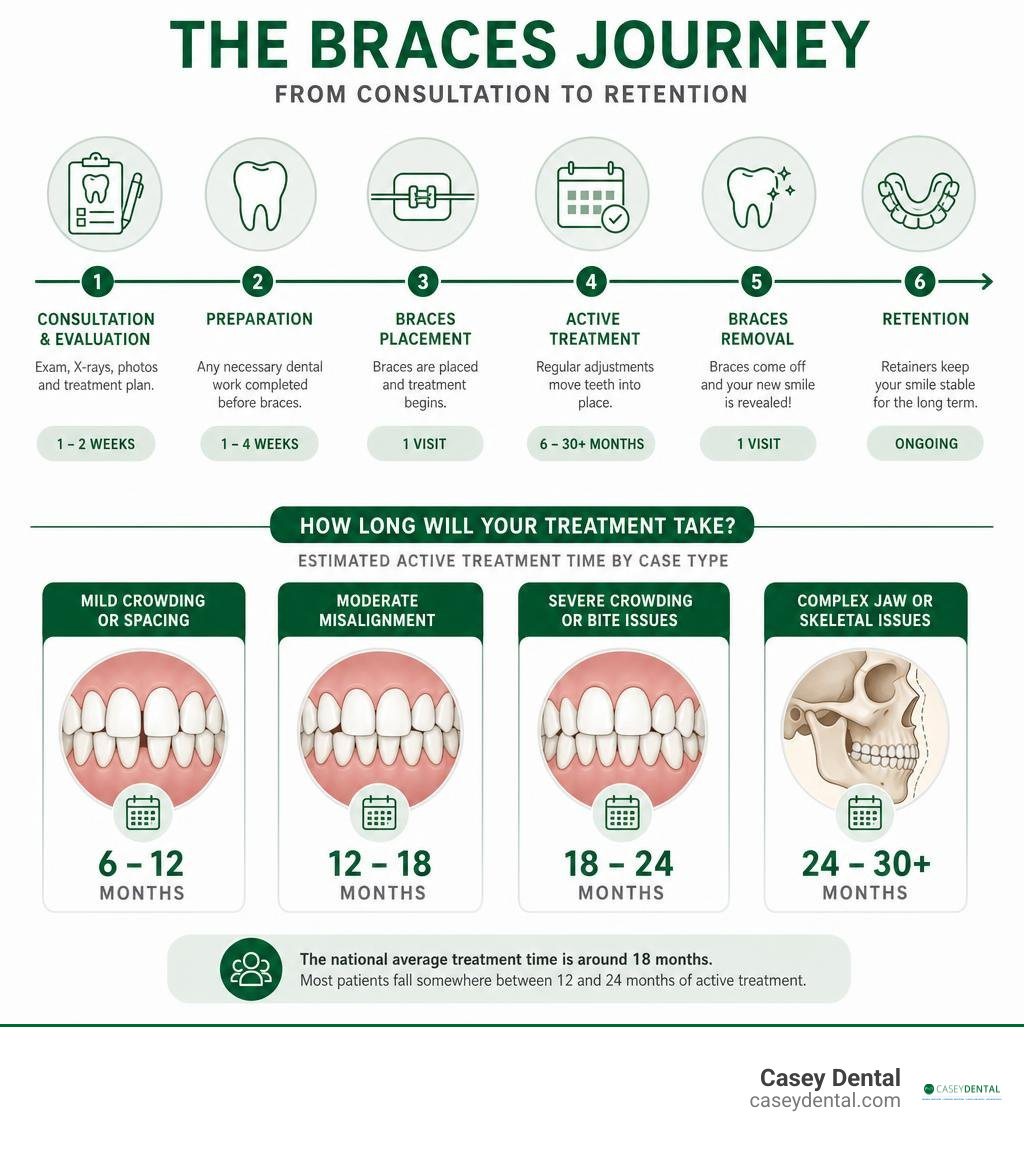
| Mild crowding or spacing | 6 – 12 months |
| Moderate misalignment | 12 – 18 months |
| Severe crowding or bite issues | 18 – 24 months |
| Complex jaw or skeletal issues | 24 – 30+ months |
The national average, according to the American Association of Orthodontists, is around 18 months. Most patients fall somewhere between 12 and 24 months of active treatment. A 2022 systematic review published in the American Journal of Orthodontics and Dentofacial Orthopedics looked at over 1,200 cases and found the median active treatment time was 19.7 months.
A few things drive that number up or down:
- How complex your bite or crowding issue is
- Your age and how dense your jawbone is
- The type of braces or aligners you choose
- How well you follow your orthodontist’s instructions
This guide walks you through every stage — from your first consultation to the day your braces come off and beyond — so you know exactly what to expect and how to stay on track.
I’m Dr. Shawn Casey, DMD, founder of Casey Dental and a practicing dentist with over 30 years of experience helping patients in northeastern Pennsylvania understand their orthodontic options, including how long do braces take for their specific situation. Having guided countless patients through treatment at our multi-specialty facility in Pittston, I’ll give you the clear, straightforward answers you need to plan your smile journey with confidence.
Terms related to how long do braces take:
Average Timeline: How Long Do Braces Take for Most Patients?
When patients visit us at Casey Dental asking how long do braces take, we always like to set realistic expectations right from the start. While it is tempting to hope for a lightning-fast transformation, moving teeth is both an art and a delicate biological process.
For the majority of patients, active treatment lasts anywhere from 12 to 24 months. According to data from the American Association of Orthodontists (AAO), the national average sits right around 18 months. Extensive clinical data, including scientific research on active braces duration, reveals that the median active treatment time across broad patient populations is 19.7 months. During this active window, continuous gentle pressure shifts your teeth through the jawbone into their ideal positions.
Why does active treatment take this amount of time? Teeth are anchored firmly in surrounding bone by the periodontal ligament. When orthodontic pressure is applied, bone on one side of the tooth root breaks down (resorption) while new bone builds up on the other side (deposition). If teeth are moved too rapidly, it can damage root structures or lead to unstable results. A measured timeline ensures both a stunning aesthetic transformation and healthy, stable bone support. For a broader look at appliances and orthodontic basics, check out our guide on more info about braces options.
Timeline Breakdown by Case Severity
The single biggest determining factor in how long do braces take is the initial position of your teeth and jaws. No two smiles are identical, and orthodontic cases are generally categorized into four primary levels of severity:
- Mild Crowding or Spacing (6 – 12 Months): Minor cosmetic adjustments—such as closing a small gap between front teeth or resolving slight overlapping—can often be corrected in as few as 6 to 12 months. In these cases, the back bite is usually already well-aligned, so treatment focuses strictly on minor alignment in the visible “smile zone.”
- Moderate Misalignment (12 – 18 Months): This is the most common scenario we evaluate. Moderate crowding, moderate rotation of teeth, or mild bite issues (like a slight overbite or crossbite) typically require 12 to 18 months. This timeline allows enough time to straighten the arch and ensure your top and bottom teeth fit together comfortably.
- Severe Crowding or Bite Issues (18 – 24 Months): Severe crowding often requires extra room, which might involve arch expansion or tooth extractions. Correcting pronounced overbites, underbites, deep bites, or open bites takes consistent mechanics over 1.5 to 2 years to achieve structural harmony.
- Complex Jaw or Skeletal Issues (24 – 30+ Months): When malocclusion involves mismatched jaw growth or complex skeletal imbalances, treatment may extend to 24 to 30 months or longer. These comprehensive cases may combine Phase 1 early intervention, surgical orthodontics, or specialized auxiliary tools to properly coordinate the jaws.
| Case Severity | Primary Characteristics | Typical Active Duration |
|---|---|---|
| Mild | Minor gaps, slight rotation, minor cosmetic overlap | 6 – 12 months |
| Moderate | General crowding, slight overbite, noticeable misalignment | 12 – 18 months |
| Severe | Heavy overlapping, extractions needed, significant bite gaps | 18 – 24 months |
| Complex | Skeletal jaw misalignment, surgical orthodontics, severe open bite | 24 – 30+ months |
How Appliance Types Impact How Long Braces Take
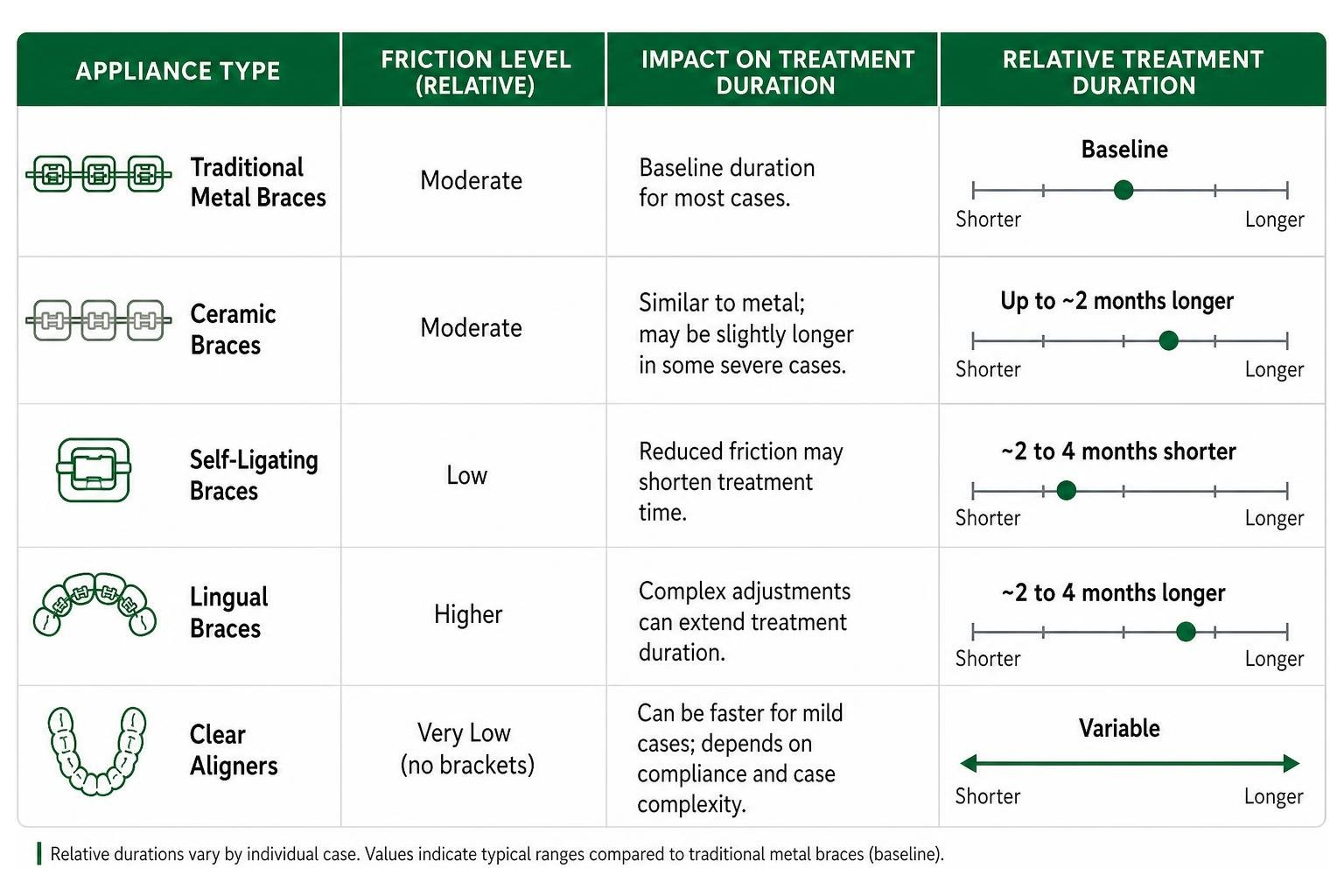
The type of orthodontic system you choose can influence your daily routine, aesthetics, and overall treatment duration. Here is how the most common appliance options compare:
- Traditional Metal Braces: Stainless steel brackets and archwires remain the gold standard for efficiency. They give orthodontists precise, 24/7 continuous control over complex tooth movements and root redirections, making them reliable for every type of case.
- Ceramic Brackets: Made of clear or tooth-colored material, ceramic braces blend in seamlessly with your teeth. Clinical comparisons published in the European Journal of Orthodontics indicate no statistically significant difference in treatment duration between metal and ceramic brackets for moderate cases. However, because ceramic is slightly more brittle than metal, orthodontists apply force carefully, which can occasionally extend treatment slightly in severe bite cases.
- Self-Ligating Braces: Systems like Damon or In-Ovation use built-in sliding doors to hold the archwire rather than elastic rubber ties. This reduces friction between the wire and bracket. While large-scale studies show the overall time savings are modest (roughly 2 to 4 months on average), self-ligating brackets often require fewer adjustment visits and are easier to keep clean.
- Lingual Braces: Attached to the back (tongue side) of your teeth, lingual braces are entirely hidden from view. Because they are custom-fabricated and biomechanically more complex to adjust from behind, active treatment can sometimes take a few months longer than traditional front-facing braces.
- Clear Aligners: Removable clear aligner systems offer a discreet alternative for mild-to-moderate cases. While clear aligners can achieve fast results for straightforward alignment, they rely heavily on user discipline. For a detailed head-to-head breakdown, explore our article on the comparison of braces and aligners.
Key Biological and Lifestyle Factors Affecting Treatment Time
While your chosen appliance sets the framework, biological factors and daily choices ultimately dictate the pace of your progress. Understanding how these elements interact helps explain why two people with similar crowding might have slightly different treatment times.

Teen vs. Adult Orthodontics: How Age Influences How Long Braces Take
Age plays a key biological role in orthodontic movement. Teenage jawbones are actively growing and developing, which makes their bone structure softer and more responsive to gentle tooth pressure. Teeth shift more fluidly in younger patients, allowing teens to complete comparable treatments slightly faster—often averaging 18 to 24 months.
Adults make up roughly 25% to 30% of all orthodontic patients today, and that number continues to grow. Because adult jawbones are fully mature and possess higher bone density, cellular turnover happens at a steady, measured pace. Consequently, adult treatment may take approximately 3 to 6 additional months compared to a teenager with the exact same bite issue.
However, adults frequently make up for this biological difference through exceptional compliance. Adult patients tend to be highly motivated, keep every scheduled appointment, wear elastics diligently, and maintain meticulous oral hygiene, keeping their treatment on schedule. If you are an adult considering treatment, check out our comprehensive guide to braces for adults.
Patient Compliance and Preventing Unexpected Delays
When asking how long do braces take, one of the most important factors within your control is compliance. Failing to follow instructions can add months to your timeline.
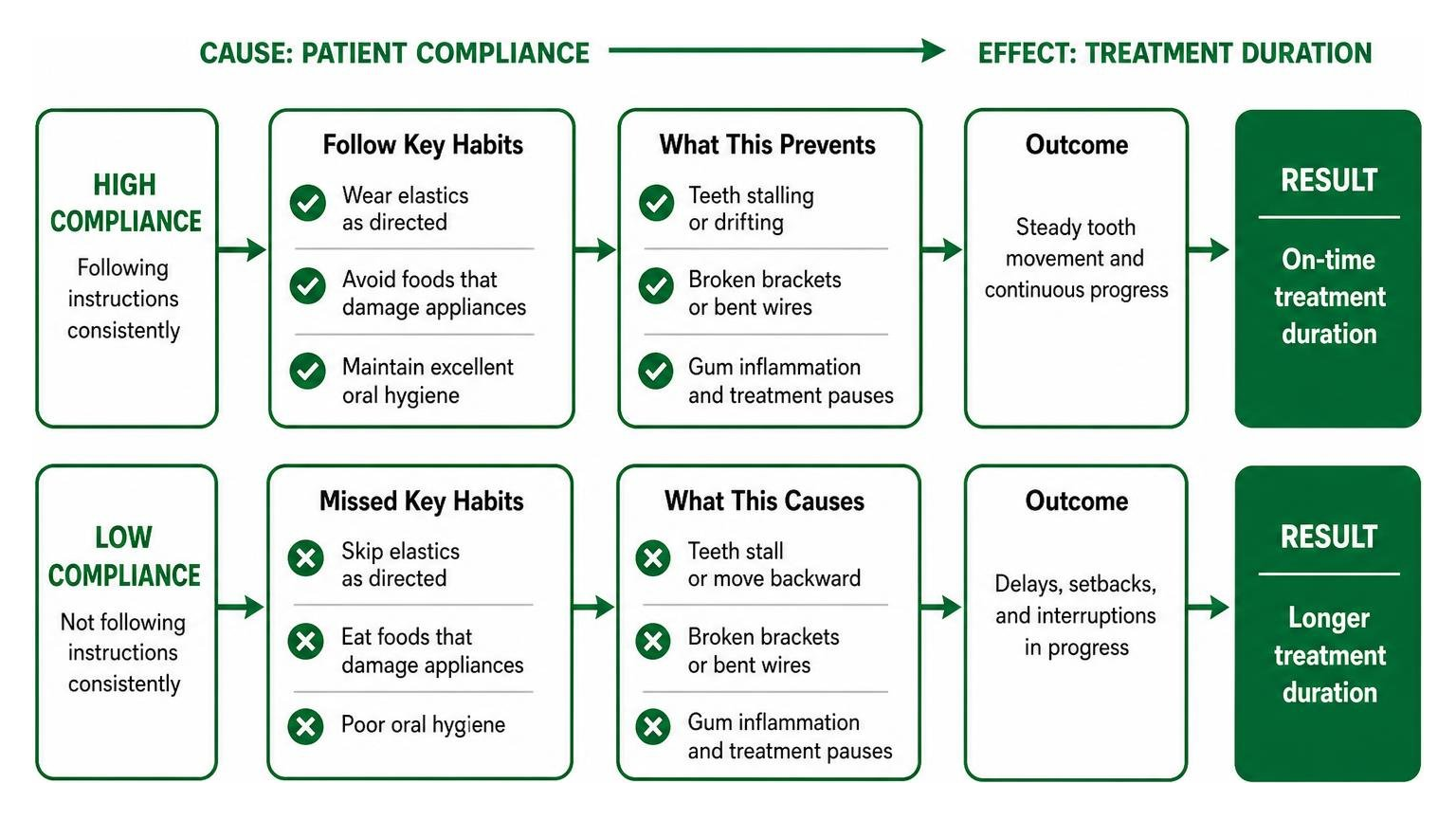
Key habits that keep your timeline on track include:
- Wearing Elastics as Directed: Rubber bands supply the precise multi-directional force needed to correct your bite. Skipping elastic wear for even a few days can cause teeth to stall or drift backward, adding weeks to your timeline.
- Avoiding Foods That Damage Appliances: Sticky, hard, or overly crunchy foods (like hard candies, popcorn, ice, or whole apples) can easily pop off brackets or bend archwires. Every broken bracket adds roughly 4 to 6 weeks to your total treatment time because active tooth movement stops until the bracket is repaired.
- Maintaining Outstanding Oral Hygiene: Brushing after meals and flossing daily around brackets prevents plaque buildup, swollen gums, and decalcification (white spots). Severe gum inflammation forces your orthodontist to pause active tooth movement until tissues heal.
- Attending Scheduled Appointments: Skipping or rescheduling routine adjustments delays wire changes and prolongs treatment.
To keep your journey smooth, review our practical tips for teeth alignment journey.
Step-by-Step Timeline: From Consultation to Removal
Understanding the step-by-step sequence of orthodontic care takes the mystery out of how long do braces take. Here is what the entire journey looks like from start to finish.

For a complete overview of the process, read our guide on the overview of the orthodontic process.
- Initial Consultation & Digital Planning (1 – 2 Weeks): Your journey begins with a comprehensive exam, digital X-rays, 3D scans, and photos. We evaluate your bite, discuss your goals, and build a tailored treatment plan.
- Pre-Braces Prep (0 – 3 Weeks): Before placement day, your teeth and gums must be healthy. This stage includes routine dental cleanings, filling any active cavities, or placing rubber spacers between back molars if molar bands are needed.
- Placement Day (1 – 2 Hours): Bonding your brackets is comfortable and straightforward. Your teeth are thoroughly cleaned and dried, a specialized adhesive is applied, brackets are attached, and the initial archwire is placed.
- Active Treatment & Periodic Adjustments (12 – 36 Months): You will return every 4 to 8 weeks for progress checks, wire adjustments, and new elastic modules.
- Debonding & Polishing (1 Hour): Once your teeth and bite reach ideal alignment, brackets are safely removed, remaining adhesive is polished away, and digital impressions are taken for your custom retainers.
Month-by-Month Progress and Adjustments
While every patient’s plan is customized, active treatment generally moves through distinct clinical phases:
- Months 1 – 3 (Initial Alignment & Levelling): Braces focus on turning rotated teeth and bringing crooked teeth into a smooth arch line. You will notice visible improvements in how straight your front teeth look early on.
- Months 4 – 8 (Space Closure & Arch Development): Archwires get progressively firmer to widen arches and close gaps left by extractions or natural spacing.
- Months 9 – 14 (Bite Correction): Mechanics shift toward coordinating your top and bottom arches. Intermaxillary elastics (rubber bands) are introduced to correct overbites, underbites, or crossbites.
- Months 15 – 20 (Detailing & Finishing): Your orthodontist fine-tunes individual tooth positions, makes tiny bends in the archwire, and verifies that your bite meets perfectly when chewing.
- Months 20 – 24+ (Final Assessment & Debonding): Once roots are aligned and bone stability is confirmed, active treatment concludes and debonding is scheduled.
What Happens After Braces Come Off: The Retention Phase
Taking off your braces is an exciting milestone, but it is not the final step of your journey. Teeth are anchored in bone by periodontal ligament (PDL) fibers, which have an underlying biological “memory.” These fibers require 12 to 18 months after braces are removed to fully adapt to their new positions.
A 10-year follow-up study cited in a clinical study on retention duration found that 50% of patients who stopped wearing retainers experienced clinically significant relapse within 5 years. Retainers protect your investment and preserve your straight smile.
Types of retainers include:
- Fixed (Bonded) Retainers: A thin, custom wire bonded discreetly behind your front teeth. It provides round-the-clock protection against relapse.
- Clear Removable Retainers (Essix style): Custom-molded plastic trays that fit snugly over your teeth. Most patients wear them full-time for 3 to 6 months post-braces, then transition to night-only wear.
- Hawley Retainers: Traditional retainers made of durable acrylic and a thin front wire, offering easy adjustability.
Frequently Asked Questions About Braces Timelines
Can braces fix alignment in just 6 months?
Yes, but only for specific, mild cosmetic cases. Short-term treatment plans lasting 6 months focus exclusively on aligning the front visible teeth for aesthetic improvements. They do not address underlying bite misalignment, overbites, or complex jaw relationships. If you have significant crowding or bite issues, a 6-month timeline is too short to achieve stable, healthy results.
How often do you need adjustment appointments?
Most orthodontic patients visit every 4 to 8 weeks. During these visits, your team evaluates progress, places fresh archwires, changes elastic bands, and adjusts mechanical pressure. Keeping these regular appointments ensures your treatment progresses on schedule without unnecessary delays.
What should you do if a bracket breaks during treatment?
If a bracket comes loose or a wire breaks, contact your orthodontist right away rather than waiting for your next regular visit. A loose bracket cannot apply force to the tooth, causing progress on that tooth to stall. Each broken bracket can add 4 to 6 weeks to your treatment length. In the meantime, apply orthodontic wax over sharp edges to keep your cheeks and lips comfortable.
Conclusion
Understanding how long do braces take helps you navigate your orthodontic transformation with clear expectations and confidence. While the average active treatment lasts between 12 and 24 months, sticking to your adjustment visits, wearing elastics as directed, and keeping up with daily oral hygiene play a huge role in keeping your timeline on track.
At Casey Dental, our team provides comprehensive, personalized orthodontic care in Pittston, PA. Whether you are exploring traditional braces, clear aligners, or require emergency repair for a broken wire, we are here to support your smile every step of the way. You can also explore specialized oral hygiene products in our online browse the patient store to keep your teeth sparkling throughout treatment. Ready to start your journey to a healthy, confident smile? Contact us today to schedule a consultation, or explore our complete resources by reading our read our complete braces guide.